alexandra alger

ABC

Archive for the category “Books”

And the Book for the Ages is…

My 16-year-old daughter sorted through her old picture books last night, the dozen or so that are still in her room and not in cardboard box in the attic. I wish I could say she was in need of the distilled wisdom, or the simple joy, that a picture book can offer. No, she was on assignment. Vanessa is a junior, which means nearly ever waking moment is dedicated to schoolwork. She was looking for a childhood favorite to talk about in Spanish class. She considered A.A. Milne (the unforgettable When We Were Very Young and Now We Are Six) and the Narnia books. Then she found it. The one book to rule them all—hidden and lost, until now.

Barbie: The Holiday Gift.
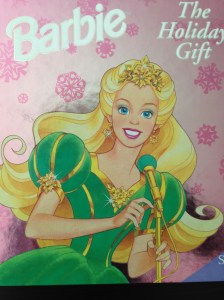
It begins like this.

One sparking winter day, Barbie hurried to the home of Mrs. Jenson, the town seamstress, to try on her gown for the Holiday Snowflake Parade. Barbie had been voted the parade queen, and her friends were the princesses. They were going to ride together on a float in the parade. “Your dress is almost finished,” Mrs. Jenson said, as she led Barbie into her sunny sewing room. “Oh, it’s lovely,” Barbie exclaimed when she saw the dress of rich, green satin. “I can’t wait to try it on.”

Barbie’s a queen of a girl, in more ways than one. Mrs. Jenson’s young niece, Laura, is shy, but she happens to have a beautiful singing voice. Barbie comes up with an idea: Laura could join her and her friends on the float and sing a song. In no time, she wins the mayor’s approval to go ahead with the singing (yes, the mayor has to get involved!), and the teens pool their money to buy fabric for a dress for Laura—pink velvet, no less. The ever talented Barbie designs the dress, which Mrs. Jensen makes in secret. On the day of the parade, Barbie surprises Laura with the dress and her idea. Laura is suitably thrilled, and ends up wowing the crowd with her voice. Laura can’t thank Barbie enough. She tells her:

“You not only gave me new friends, you helped me overcome my shyness. Those are the best gifts I’ve ever received.”

But Barbie has the last word.

“You gave those gifts to yourself, Laura, by sharing your voice,” Barbie replied. “And what’s more, you also gave all of us a very special holiday memory.”

Oh, so many special gifts!

I read this book over and over to a rapt Vanessa. So did her beloved babysitter, Carla, who gets the credit (no blame!) for buying the book.

The stilted language, the lackluster story line—Vanessa never noticed. She couldn’t get enough of those dresses. Oh, the dresses. Aside from Barbie’s blindingly green dress, there was Laura’s. That might’ve been Vanessa’s favorite. It had ruffled tulle-ish sleeves, gold ribbons and—gasp—a rose at the waist. Barbie’s four princesses also wore gowns on the float, each a different hue—pink, yellow, blue, and oops, another pink, a deep, dusty color that I can’t seem to find a better way to describe. Which was the prettiest? We pondered this endlessly. (Unbeknownst to her, I thought they ranged from hideous to only slightly less dreadful.)

“I think this book made me think about fashion for the first time,” Vanessa said, with only a hint of sheepishness.

Barbie, a fashion inspiration? I guess that’s not so hard to believe, when the person being inspired is all of four years old. Vanessa did not fall in love with Barbies, though. Not like I did. I spent years happily playing with Barbie and like dolls. Many experts argue that Barbie’s outrageous proportions give girls the wrong idea about what’s a healthy body size. That could well be. I don’t remember thinking about Barbie’s body—except to be amused that she had leg hinges where her butt should be. I didn’t care to see her naked; the whole point of having a Barbie was to dress her. My grandmother used to make clothes for my Barbie. (She wasn’t Barbie herself, actually; she was a brown-haired chick with bangs, quite pretty ’til I dabbed lipstick on her and the lipstick rubbed off, staining her face.) Putting clothes on, taking them off, putting something else on—it was all so deeply satisfying and enjoyable.

What I suppose I’m saying is: I had a positive Barbie experience, and my daughter did, too. As to The Holiday Gift: Now that Vanessa’s rediscovered it, I’m clearly going to have to save it for her. Who knows—it could end up being something she passes down to her daughter, this little board book, published by Fun Works in 1997. It’s still out there, in a small way. I found it selling for a buck, used, on amazon. There’s a whole new line of Barbie books, I see. Now she’s a modern-day princess with…super powers! And also a vet, a pediatrician, a teacher and a ballet dancer. I’d like to see Barbie the engineer, or Barbie the astrophysicist, or Barbie the head of Goldman Sachs. Perhaps I’ll find our Barbie book again when I’m, say, helping Vanessa pack her things to move to her first house. That’s got to be a good eight, ten years from now. We’ll see what Barbie’s up to then.

Mark Twain and the Bohemians

Recently I was lucky enough to meet Ben Tarnoff, the author of The Bohemians: Mark Twain and the San Francisco Writers who Reinvented American Literature (2014, Penguin Press). Ben happens to be my neighbor’s son-in-law, and he graciously agreed to meet with our book group. Bohemians is an engaging, colorful account of a period of American literary history that I for one knew nothing about. Ben focuses on the four best known San Francisco-based writers of the post-Civil-War period—Twain, Bret Harte, and the poets Charles Warren Stoddard and Ina Coolbrith (the first poet laureate of California). Twain and Harte wrote bold, irreverent California-based stories, fiction that was new and wholly American.

Now–I haven’t finished the book, and while I can highly recommend it based on the two-thirds of it I’ve read, I’m bringing up Ben because of what he said about the writer’s life–his own. I asked him if any part of the book had been especially difficult to write, and he said, “All of it.” He said he’d finish every day of work convinced the pages he’d just written were absolutely terrible. If he felt jazzed about what he’d written, he was sure to find it abysmal the next day.

A successful young writer (he’s also the author of A Counterfeiter’s Paradise, a history of the early years of the American financial system) doubting his abilities at every turn. What else is new, you say? True enough, but it’s always comforting to hear a published writer confess his or her insecurities. I almost felt a stab of pity: I feel good about my writing some days; I don’t think it’s awful every day! I almost got there, to the stab, but I only got as far as near pity. The fact is, whatever his method is, it’s working. His book is beautifully written (at least the part I’ve read is). And I look forward to his next work, whatever that may be—and good Lord, we didn’t even get around to asking him what he was working on.

As I gaze into the empyrean….

It’s been a while since I’ve run across a word that’s made me sit up and take notice. Here’s one: empyrean.

It’s another word for heavenly or celestial. It specifically refers to the highest reaches of the heavens, a sphere composed of pure fire or light, according to ancient and medieval cosmology, so says Merrriam-Webster online.

Empyrean. Em-peer-ee-an. Oxford Dictionaries online provides a list of rhyming words, most of which (oddly but amusingly enough) derive from Greek mythology or geography: Caribbean, Cyclopean, Fijian, Herculean, Sisyphean, Tanzanian…Oxford, how about just any word that ends with the sound “ee-an”?

Wiki tells me I’d know this word if I’d gotten around to reading Dante’s Divine Comedy.
Oh, well. As it happens I found this word in Anthony Doerr’s mesmerizing All the Light We Cannot See. At least I think I did—for the life of me I cannot re-find it, even though I’m sure it was used to describe the 133-carat diamond that is both a wonder in the novel and a wonder of the novel.

Empyrean. It can be used as a noun (the empyrean) or an adjective (and there’s also empyreal). I wonder if I can figure out how I can use it without sounding pretentious. Doerr can get away with it, because he’s a gorgeous writer. He doesn’t use many fancy words; he uses the right words. If you haven’t read this book, try to!

Sheila Turnage’s Three Times Lucky

Does Sheila Turnage have a way with words! Mo, the twelve-year-old heroine in her 2012 debut middle-grade novel, Three Times Lucky, wouldn’t know a cliché if it hit her in the face (and she’d never use that tired old expression). Think how hard it is to find an interesting way to describe a heart racing with elation or fear. Mo: “My heart leaped like the cheerleader I will never be.” Here’s another nice line: “Uneasiness ran its fingertips across my shoulders.” And when she’s down: “I feel like a sky without stars.” You want to read this book now, don’t you?


Siobhan Vivian’s The List

My newest guilty pleasure is ordering a book on my iPad and starting to read it right then and there, in the middle of the day, when there are other more important things to do–like work on my novel revision. My latest download was The List, a YA contemporary novel by an author with an incredibly cool name, Siobhan Vivian. On her blog, literary agent Molly Jaffa called it one of her favorite books of 2012. I’d never heard of it, so I idly checked out the first page on Amazon. Well. I had to download it immediately. This is the first sentence: “For as long as anyone can remember, the students at Mount Washington High have arrived at school on the last Monday of September to find a list naming the prettiest and the ugliest girl in each grade.” Irresistible, right? Vivian gives a voice to each of the eight girls during the week before the homecoming dance. Being named one of the prettiest confers instant fame and popularity–or for those who were already popular, like Margo, affirmation of the status quo. Could anything go wrong once you’ve been named one of the prettiest girls in school? As it turns out, yes. Being on the list pushes Bridget into the grip of anorexia just as she’s trying to escape it. The friends Lauren attracts, thanks to her new status, convinces her mother to withdraw her from the school against her will. Counter-intuitively, the girls on the ugliest list weren’t as bad off as I expected them to be. I figured they’d be devastated, humiliated to the point of disfunction. That’s how I would’ve been. I would’ve had to switch schools. I would’ve needed therapy. One girl, Jennifer, who’s made the list every year of high school–a record–is indeed a mess. Thank goodness she’s a senior, because she needs to get out of town, asap. But the other girls rally They work through the shame and anger. Granted, they aren’t actually physically unattractive, and two of the three have boyfriends. But wait a minute. Am I saying these girls aren’t ugly enough to be on the ugly list? If I start to judging who is and who isn’t, I’m no better than the list maker. Ms. Vivian: I’m better, I swear! If I had the power to put an end to the list, I’d do it. I really would.

Wonder, by R.J. Palacio

href=”https://www.goodreads.com/book/show/11387

Post Navigation