alexandra alger

ABC

GoButler, Chapter 2

Update on GoButler, the free text-based butler service I joined a few weeks back:

If you read my original post, you know that I was put on a waiting list for my “butler.” Eleven days later, I got a cheery text: “Hi and welcome to GoButler! 🙂 I’m Ian—what can I help you with today? I can order food, make reservations, book travel…whatever you need!”

Naturally, I sent back a cheery hello and a I’ll be in touch soon. Funny thing was, with my husband’s birthday out of the way (it was a big success—I’m off the hook for another year), I couldn’t think of a task for Ian. Order groceries for delivery? Giving a list to Ian to give to some delivery service is more work than my doing it myself (Freshdirect couldn’t be easier). Order take out? I suppose I could say, “Ian—one order of Massaman curry, thanks!” but that would go against the grain. Like many New Yorkers, I have my usual places I order from; I don’t want curry from just anywhere. I suppose I could ask Ian (Eloise-like), “Please order me Massaman curry from Café Chili on Court Street, thank you very much!” But….am I really so busy that I can’t call Café Chili myself? Honestly, I’m not too busy to call myself.

So I didn’t contact Ian right away. A few days went by. He must’ve guessed I was at a loss. Or maybe he just needed something to do. He sent this: “It’s Wine Wednesday—let GoButler get you some nice old grape juice, some cheese, and help you unwind. Let me know if you’re interested and I’ll get started! :)”

I was charmed by his idea—wine and cheese! I happened to be in St. Louis last Wednesday night, but I suggested I might order some wine for Friday night. A rosé, for toasting the final days of summer.

But what bottle, exactly? This would not be an issue if I were stopping by the neighborhood wine shop. I’d swiftly choose a bottle in the quasi-random way I usually do. I could’ve asked Ian for advice, but that seemed risky. I suggested a Sancerre rosé, about twenty bucks, which I remembered having earlier in the summer and liking.

I asked where Ian was going to shop for the wine, and he told me GoButler used an online service called MiniBar that checked pricing and availability in stores around me. So far so good, but then guess what—Ian informed me that Minibar had a minimum of $25 for a delivery.

Ha! There it was, the catch: If you want your butler to order you wine, you gotta spend at least $25. I couldn’t offhand think of a $25 bottle of wine, so I added an Albariño to my order. Total spent on my GoButler experiment: $40 (which I paid through a link GoButler sent me, connecting me to PayPal).

The wines were really nice. I suppose I could see myself texting Ian some Friday to send over another bottle of that rosé. But I think I’m much more likely to stop by my local wine shop.

It seems clear that for GoButler to succeed, people like me have to order frequently and spend more money than they might otherwise spend. I may not be the ideal client, but Ian may get a bit of work from me yet. I wonder if he knows who gives the cheapest facials in the ‘hood?

Oh, Jeeves….

I know there are all kinds of apps out there that will do almost anything for you, but I’ve never gotten on the bandwagon until now. GoButler (gobutler.com) is text-based and free. You sign up on the website—by which I mean, you type in your cell phone number—and you’re on the way to getting your own Jeeves. For the cost of whatever it is that you ask for, your butler will deliver sushi, make dinner reservations, find theater tickets, arrange travel, and, theoretically, do anything you ask, as long as it’s legal. (The website specifically mentions this. Think how big GoButler’s pot-delivery business will eventually be!)
My daughter, Vanessa, is the one who discovered GoButler a few days ago, and when she told me about it I understood in a flash we urgently needed a butler. Why? My husband’s birthday is coming up. He’s one of those guys who actually buys stuff for himself. Clothes. Gadgets. Shoes. Underwear. (Really nice underwear, too.) But he also happens to love presents, especially on his birthday. You can see where such a situation leaves me: First, in a state of denial, which leads to lengthy procrastination. Then panic, and a burst of random shopping a few days before the birthday, August 18, ending in the purchase of the first nice shirt I find. This year, I’ve managed to find a short-sleeved button-down with a cool gray water pattern—perfect for casual Fridays, yes?—and a sophisticated navy button-down that was frankly a panic buy, but he really could use a navy shirt, I’m sure of it.
But when Vanessa looked up for her computer with the news about five-month-old GoButler, and its phalanx of eager-to-please, one-text-away personal assistants, I saw a game-changer. I imagined Dan, thrilled beyond measure at receiving a fantastic birthday present; a present I didn’t have to find. “I could ask for three suggestions for cool gadgets for a fifty-year-old who thinks he’s a hip thirty-year-old,” I said happily.
“And they could tell me what I could get him for under forty dollars,” Vanessa added.
She signed up immediately; I figured there was no need to be greedy; we could share a Jeeves. And that’s when we learned the catch: The service is so popular there’s a waiting list.
Rats.
I see the silver lining, and it’s a thick, bright thing: If Vanessa is assigned a butler sometime this fall, I can get him or her working on Christmas-gift ideas.
A terrible thought just came to me: Is it possible coming up with gift ideas isn’t on the list of butler services? Say it ain’t so!

Agatha Christie and the Color Puce

What color is puce?

I haven’t read or heard the word “puce” in ages—possibly not since childhood, when children’s books were full of orphans dressed in hand-me-downs that were some drab color—if not brown, then gray, or…puce! I feel sure I bothered to look up the exacting meaning; it was so obviously an ugly color, just from the sound of it. Phew! with an “s” at the end.

Then again I may well have first encountered the word in Agatha Christie’s 1972 mystery, Elephants Can Remember, which I just unearthed and am happily rereading. The book opens with mystery writer Ariadne Oliver considering a hat to wear to a luncheon. The hat she chooses is a “kind of turban of various layers of contrasting velvets, all of rather becoming pastel shades which would go with anything.”

I can’t for the life of me imagine how such a hat could go with anything at all. Anyway. The main point is, she pairs the turban with a wool dress “of a delicate puce color.”

There it is. Puce. A color that apparently can be “delicate” or—presumably—vibrant. And might (though my faith in Mrs. Oliver’s taste is now shaky) go with a number of other colors. Mrs. Oliver mentions the colors in her hat —green, blue, red and chocolate brown (Why Mrs. Oliver calls the latter two pastels is beyond me.) There is no way to guess, based on this welter of info, what color this wool dress is.

I look it up, and it turns out there is some disagreement on what color puce actually is.

Grayish pink? Light green? Maroons brown? All these shades pop up online as puce. And that’s not all. It’s “dark purple brown,” or a “brownish purple,” asserts that eminent source, the OED, which obviously has two constituencies to please, those on the side of purple, and those who insist on brown. This is one strange, and let’s face it, ugly, set of possibilities.

Who would set off such a debate? The French may have that dubious honor. Puce is the word for “flea” in French. That’s right: Puce literally means flea-colored.

Oh, the French and their love of fleas! They use “puce” as a term of endearment, such as calling a child “mon petit puce” (my darling little flea). “Flea market” is a literal translation from the French for a market that sells second-hand goods likely to be flea-infested. Personal hygiene being low on the list of priorities in past centuries (even until recent decades, some may argue), I’d wager that the French have a long, intimate history with fleas.

A historical novelist named Catherine Delors avers that France’s King Louis XVI—the one who met his end at the guillotine in 1793, along with his infamous wife, Marie Antoinette—coined “puce” to describe the color of one of his wife’s favorite gowns. On her blog Versailles and More, Delors has a picture of a scrap of this gown, put up for auction at Christie’s a number of years ago. It looks to be a light brown, what I would call the color of dark honey; banal, as royal colors go, and certainly not dark purple brown. Had it perhaps faded or gone through some sort of change over the course of two hundred-odd years? (This question may not have bothered the buyer of the scrap, who paid $76,000 for it, according to Delors.)

Can a flea be a variety of colors? A site called fleabites101.com says there are about 2,000 different kinds of fleas around the world, so maybe so—though this source says they are brown or reddish brown and doesn’t elaborate. I have to admit that I’ve been lucky enough never to have seen a flea up close. On another site, I found pics of a cat with fleas—and believe it or not, they were light brown. Louis XVI might’ve been a connoisseur of cat fleas.
Still the question lingers: What is the color of Mrs. Oliver’s wool dress in Elephants Can Remember? If only Agatha were still alive. What was puce to Agatha Christie in the early 1970s?

If we start with the assumption that Agatha has given Mrs. Oliver a modicum of taste—the unfortunate turban aside—green might be the color: a pale green, not quite pea but close. Louis’ brown might work, too. It’s probably not dark purple brown, but it could be a lavender with a hint of beige. Pink is out, unless Mrs. Oliver were one of those women who liked pairing red and pink.

Oh, well. There’s no way to know. Agatha has unthinkingly created a small unsolved mystery. The only conclusion about puce I can make is what I knew at the start—it’s probably hideous. Except one: The one true essence of puce, we can say, is it’s a Vomitous might be another word for it. Might Marie Antoinette have kept her head had she not been fond of puce?

Into the Woods

I spent the last two days and two nights without wifi or cell-phone service (or land-line service, either).

You’re wincing, aren’t you? You’re trying to imagine being out of range for one day; half a day; a few hours. I was the same way. I was really kind of dreading this trip. I was sure something terrible was doing to happen, and I wouldn’t be able to get help in time.

Where exactly was I? My husband Dan and I stayed in a hunting lodge on a lake in the Adirondacks. On a pristine body of water called Boreas Pond. The property is part of a 161,000-acre tract that the Nature Conservancy purchased from a local paper company and is in the process of selling to the state of New York as protected public land.

Dan is head of the board of the New York State chapter of the Nature Conservancy. That’s the kind of volunteer job that leads to a chance to spend two days magnificently alone in the Adirondack wilderness with your wife. Alone in this case meaning seven miles of dirt road away from other humans (and cell-phone service).

I was awed at the thought of such isolation, even as it gave me acute anxiety. I was channeling Woody Allen. There I was, marveling at the beauty of the lake—in color nearly black, from tannins—and at the same time having visions of disaster, principally: Dan having a heart attack on a trail. A bear, mauling him. A strange upstate bug giving him a serious allergy attack (He gets horrifically large bug bites). I can’t tell you my relief when a TNC staffer showed me the satellite phone and and a kind of emergency pager connecting us to rangers who would descent on us like ants on a picnic.

So we’d be all right. We had life lines. But what about bears? Moose? Snakes? Mike Carr,
head of TNC’s Adirondacks chapter, assuaged my fears. Bears—he couldn’t remember the last time he’d seen one. Moose—not interested in humans. Snakes—no poisonous ones, anyway. I started to relax. A little. Then a bit more.

After a turkey sandwich and a Shiner Bock on the front porch, clouds rolled in. When the rain began, our choice was clear. We stretched out on the leathery hunting-lodge couch and napped. It was delightful. I can’t remember the last time I took a nap in the afternoon. Who has time? There, we did.

We had the time to paddle on the lake and consider that we were the only humans there. I imagined I were a native American, surveying the forest where I would late hunt white-tailed deer. The Last of Mohicans, with Daniel-Day Lewis, was filmed in the Adirondacks. Remember how DDL ran in the woods, swiftly, gorgeously, his hair flowing behind him? The film crew had to have bushwhacked a path for him. There’s just no way he could’ve run in these woods. We didn’t even try to walk in them. The pines and aspens and fir trees (and others) compete for how closely they can grow together, and whatever space remains is clogged with dead branches and stumps. (Kudos to the hunters, who come in the fall to shoot deer. I don’t know how they get through the thicket. I’m not sure how the deer do, either.) We hiked up a dirt road that was once used as a logging route, wondering what creatures might be hearing or seeing us. We saw moose and deer tracks, but the creatures themselves kept their distance.

When did more reading than we usually do. Dan inched closer to finishing David Foster Wallace’s behemoth, Infinite Jest. I devoured two 1950s paperback westerns I’d picked up for 50 cents each at a local store. We talked—or didn’t. When you have all kinds of time to talk, you find you don’t always need to. We made burgers and drank beer and struggled to stay awake long enough to see the stars in a sky without any ambient light. (We missed out; a night haze obscured the stars.) When we rolled onto the paved road and the bars on my phone appeared, I felt a pang of regret. A life without the unending buzz of texts and calls and emails: It was wonderful.

Summer Ease

IMG_2015

I had fresh corn for the first time this week. Heaven. I live for fresh corn. I can’t get enough of it. I gorge on it all summer, and then suddenly, just as the air grows chillier and the corn kernels harden, I find I can’t stand one more ear. I’m ready for turnips and cauliflower.

I haven’t posted a recipe in a while–just haven’t been inspired in recent months–but the arrival of corn at my local markets has gotten me fired up to share this incredibly easy, fast and delicious tilapia recipe, served with steamed corn and collard greens stir-fried with garlic and olive oil.

Sheila Lukins’ Tilapia (from cookstr.com, slightly amended)

Yield: Serves 4

Ingredients:

Spice mixture:
1 tsp. salt
1 tsp. sweet paprika
½ tsp. ground cumin
¼ tsp. Old Bay Seasoning (I’m not entirely convinced you need this)
¼ tsp. garlic powder
¼ tsp. dried thyme
¼ tsp. dried oregano
¼ tsp. dry mustard (I don’t use if I don’t have)
¼ tsp. freshly ground black pepper
¼ tsp. cayenne pepper (I don’t always use this, either)
Pam cooking spray
4 tilapia fillets (about 6 ounces each)
4 lime halves, for garnish

1. Preheat oven to 400 degrees

2. Prepare the spice mixture, combining all the ingredients in a small bowl.

3. Coat pan with Pam spray.

4. Spread fillets with the spice mixture on both sides. Spray top of then fish with Pam.

5. Bake for 1-12 minutes, until the fish flakes.

6. Serve immediately, garnished with lime halves.

I have to share this recipe, too, because it’s the dessert equivalent of the Tilapia dish–no, it’s even easier you don’t have to worry about whether you have Old Bay seasoning or if you remembered to buy dried mustard. As long as you have a pint or two of blueberries around, or a few fresh plums–both so plentiful in the summer–you can make this last minute. It’s so easy you won’t believe it actually tastes good. The fruit melts into a crusty, buttery cake. It’s even better for breakfast the next day. My friend Ellen Newman, a Cobble Hill, Brooklyn, neighbor, is the genius behind it.

Ellen Newman’s Fruit Tort

Ingredients:

I cup flour

I cup sugar

1 stick of salted butter, melted

1 tsp. baking powder

2 eggs

Pinch of salt

A couple of plums, peeled and sliced; or two pints of raspberries; or one-two pints of blueberries.

You’re wondering about milk, aren’t you? Nope. There’s no milk involved. No other liquid–just go with it!

1. Preheat oven to 350 degrees

2. Mix together everything but the fruit in a greased and floured springform pan.

3. Gently put fruit on top.

4. Bake for 45 minutes to an hour, until the top is golden.

Write me if you try this. I need to know that despite your reservations about how this could possibly turn out, it did, and you were thrilled.

Inspiration from Rafa Nadal: Fight!

I’ve been glued to the French Open this week. ESPN and Tennis Channel make watching live tennis from around the globe just so easy. Too easy. And I’m so weak! I could’ve taped matches and watched them after writing hours. Of course I could have. And I clearly have to develop some discipline before Wimbledon begins in a month. I admire the red clay and the gritty play of Paris, but I love the elegance of grass courts and players all in white (and it is kind of fun when the camera finds a royal or two). I remember the days when Roger Federer ruled the grass, and he’d appear on Centre Court in a crisply tailored white jacket that he wore solely for that walk to his chair before his match.

Yesterday, with my computer in front of me, patiently waiting for my attention, I turned on the Rafa-Djokovic French Open quarter final. There wasn’t much to watch, sadly. Rafa Nadal, the King of Clay, who has won a record nine French Open titles, was trounced in straight sets.

Shocked? Yes. Surprised? No. Most commenters had been expecting Djokovic to win. Nadal has struggled in recent months. He didn’t win even one of the clay-court tournaments that he usually dominates and has dominated for nearly a decade. Then again, he’s got good reasons for not being at his best. He had an appendectomy at the end of last year, and has been dealing with back, wrist and knee issues.

Some commenters have already declared him past his prime. They aren’t saying his career is finished, but coming awfully close. It seems to me that anyone who’s watched Rafa for any length of time would know that he is nowhere close to retiring.

He just took the biggest beating of his career (arguably), and what does he take from it?

This is what he said after the match:

”I accept the defeats and there is only one sure thing: I want to work harder even than before to come back stronger. I am going to fight.”

I am going to fight. This from a man who’s already in the history books as one of the best of all time. He’s won 14 Gram Slams, tied for second place with Pete Sampras (behind Federer, who’s won 17). It’s incredible that he still has the fire to achieve even more. Nadal is my inspiration this week. You have to work hard and harder and fight for what you want.

Max de Winter and Elizabeth Bennet–in the same sentence!

I found myself taking Rebecca off the bookshelf. Not to re-read it, which I’ve done a number of times over the years. I’d been thinking about how to handle someone was not answering my phone calls or emails about an important matter, and how personally I should take this, when all of a sudden I thought of Max de Winter, impassively tolerating Mrs. Van Hopper and her vulgar questions.

Strange, isn’t it? Max de Winter. Why on earth should I think of him and Mrs. Van Hopper? I read Rebecca when I was in my teens. I remember finding Max attractive, for a middle-aged—his face “arresting, sensitive, medieval….” I understood why the naive young narrator married him (not that she had much choice—staying with Mrs. Van Hopper was a no go).

Reading again those early pages in which the narrator and Max meet, I now see that Max wasn’t much of a role model, at all. In his future wife’s eyes (and my teen-aged ones), his manners are irreproachable, and if he is distant, it’s because he has to be, to keep the Van Hoppers of the world at bay. But really, as we learn later, his aloofness is a form of self-protection. He’s riddled with guilt. Taking a broader view, he’s a terrible husband to his young second wife. We know he has his reasons—and he shapes up, sort of—but he’s no kind of role model.

If we’re talking strictly about how to handle difficult people, I would try to learn from Elizabeth Bennet, my favorite Jane Austen character. She refuses to sugarcoat the truth, but manages to express it with uncommon adroitness. Think of how she handles her first marriage proposal, from Mr. Collins. She tells him “no” three times, and he still refuses to believe she’s not simply being coy in the way of “elegant” females. She cries, “I do assure you, Sir, that I have no pretension whatsoever to that kind of elegance which consists in tormenting a respectable man. I would rather be paid the compliment of being believed.” One of my favorite scenes in Pride and Prejudice is when Lady Catherine de Bourgh tries to bully Elizabeth into rejecting an offer of marriage that she has heard—erroneously—that her nephew Darcy has made. Elizabeth coolly holds her own against the snobbish old woman, telling her whether or not she marries Darcy is her own business. “How far your nephew might approve of your interference in his affairs, I cannot tell; but you certainly have no right to concern yourself in mine. I must beg, therefore, to be importuned no farther on the subject.”

Oh, to have a reason to use that last line!

So what would Elizabeth do, faced with my dilemma, a person who refuses to engage? She isn’t one to shy away from a challenge. I’m guessing she would, in all good humor, continue to call until she reached him. And that is what I will do.

Je Suis Charlie, Toujours

I’ve been reading up on how the PEN gala in New York went down last Tuesday, and am pleased that it seemed to have gone smoothly, with a standing ovation for the surviving members of Charlie Hebdo.

And three of my heroes—the writers and graphic-novelists Neil Gaiman, Alison Bechdel and Art Spiegelman—agreed to host the tables relinquished by writers protesting PEN’s decision to honor CH.

Splendid writers—Francine Prose, Peter Carey, Michael Ondaatje, Teju Cole, Rachel Kushner and Taiye Selasi, and many others—who came to a strangely wrongheaded view that CH is racist.

I applaud what Michael Moynihan wrote in the Daily Beast on May 5:

“Should you trust the judgments of newly minted French satire experts, most of whom don’t speak French and have never held a copy of the newspaper? Or should you trust Dominique Sopo, the Togolese-French president of SOS-Racisme, France’s most celebrated anti-racism organization, who made the obvious point that Charlie Hebdo was the ‘most anti-racist newspaper’ in the country? Those accusing his murdered friends of supporting the very things they so passionately opposed, Sopo said, were either motivated by ‘stupidity or intellectual dishonesty…Every week in Charlie Hebdo—every week—half of it was against racism, against anti-Semitism, against anti-Muslim hatred.’”

Vegas!

IMG_1854

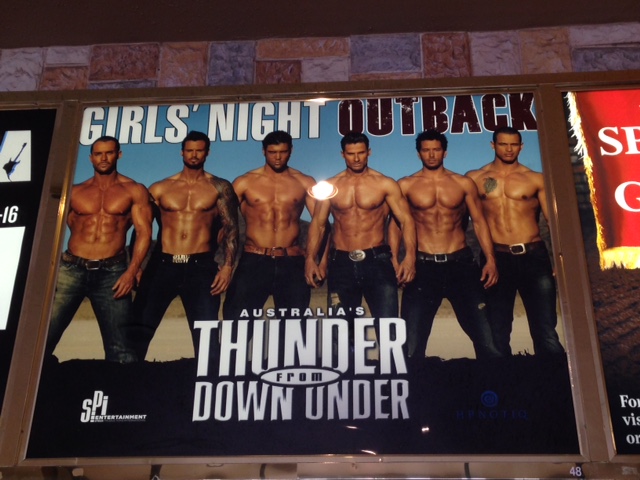
Nope. I didn’t see the Down Unders.

IMG_1815

Or Tyson. He’s sure looking good (he’s 44 now! How did that happen?).

I also didn’t gamble.

Before you think I’m utterly lame, listen to what I did do, on a girls’ weekend with three college friends:

—Got tattoos: an arm band and a dragon tramp stamp. Okay, not real: decals. But it’s the idea that counts.

—Saw David Copperfield. Yes, he’s still alive and performing two shows a day–and three times on Saturdays–at the MGM Grand. He can be dazzling–he made a vintage Cadillac appear out of nowhere! And a massive mechanical T-rex!–and so cheesy you can’t believe it. One of his acts involved a tiny blue “Martian” that needed the audience to help him get back to his home planet. A six-year-old might’ve liked this act, maybe, but Copperfield’s audience has more sixty year olds than six year olds (not to mention lots of tourists with a tenuous grasp of English; they must’ve been wishing DC would just get back to making things disappear).

—Checked out the Venetian’s fake canal, with warbling gondoliers, its fake cerulean sky overhead, and people eating in an “outside” Italian tratteria; the Luxor’s soaring pyramid and fabulous Sphinx (see selfie below); and the Bellagio, which was not so impressive. Maybe that’s because we didn’t get to see the Picasso paintings for which Bellagio is renowned. Oddly, they’re hung in a restaurant, which wasn’t open during the day (weird, surely?).

IMG_1853

What was glorious–and eventually exhausting–about Vegas were the voluminous crowds. Where is everyone? They’re in Vegas! There were moments when I thought that the broadest diversity of humanity anywhere in the world had to be right there with us on this five-mile strip. All kinds of people, young and old, from all walks of life. Even toddlers. Yes, we saw families with toddlers, strolling through the slot machines–the air stinking of cigarettes and booze–as if they were in a beautiful park somewhere. And untold numbers of young women on bachelorette weekends in stilettos and skin-tight barely crouching covering outfits. Every bride-to-be had an identifying sash or hat. One group was wearing T-shirts that said, “Look like Jackie, act like Audrey, party like Gatsby.” Only the last reference makes any sense in the context of Vegas.

I’d been meaning to try a slot machine, at least. I could not figure out how to work the damn things! There’s a slot for a credit card, I guess, but no way to know how much money you’re putting in, and then what in earth to do to play the game. But all these old people are playing away, losing their money–how hard can it be? Finally, I got my chance. At the airport, where the lame slot machines go (there was about dogs, for instance). I asked the young woman what the deal was. She showed me a dollar machine and said, “It really isn’t that hard. It’s just a question of how much money you want to spend. The more you spend, the better your odds are.” She must’ve thought I was the dumbest person on the face of the earth to ask that question.

I slipped a dollar into a dollar machine called Triple Diamond. The machine coughed and spat my dollar out. I tried again. Same thing happened. Well, then. I slipped my dollar back into my wallet.

Clearly, I wasn’t meant to gamble in Vegas. Not this time, anyway.

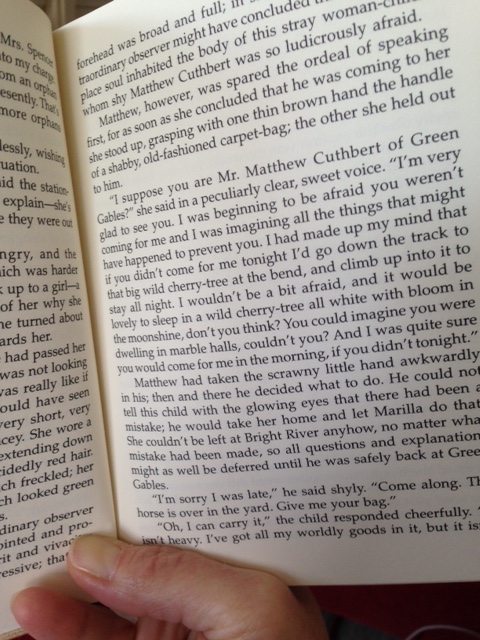
Revisiting Anne of Green Gables

IMG_1808

I didn’t pay attention the first time I saw news about the death of Jonathan Crombie, the actor who played Gilbert Blythe in CBC’s 1985 TV adaptation of Anne of Green Gables. Yesterday, though, I found a posting on Facebook of a New Yorker article called “Why We Loved Gilbert Blythe.”

Well. I had to read that.

It turns out teenage girls all over fell in love with Crombie as Gilbert in this mini-series. “Crombie gave Gilbert caring, intelligence, and dreaminess: qualities that enchant seventh-grade girls,” Sarah Larson writes. I missed Crombie and all his dreaminess. I was in my early 20s in 1985, just out of college and living in San Francisco. I don’t think I had a television in those days. I feel sure I would’ve been tempted to watch, having been an avid reader of the whole Anne series. But I can’t feel too sorry that I missed it. Crombie sounds a bit too milktoasty for my taste. Larson prefers Crombie to the Gilbert of the books. She finds him “kinder,” with “lively” instead of “roguish” eyes, and without the mouth “twisted into a teasing smile,” as author L.M. Montgomery describes him.

Of course Gilbert is roguish! He has to be. Only a mischievous boy would call Anne “carrots” to try to get her attention, and kept trying, even after she breaks her slate over his head and refuses to accept his apology. A kinder boy wouldn’t have dared the “carrots” jibe, and there would’ve been no Anne and Gilbert, which is unthinkable.

I’ll admit Crombie looks the part. He’s got the build and coloring you’d expect, and that’s huge. And if intelligence and caring come across—well, I imagine I could fall under his spell, given the chance.

The production didn’t quite get Anne right—at least in the looks department. I looked up the photos of Megan Follows, cast as Anne, and she’s pretty and fresh-faced in a way that Anne isn’t. She was also a seventeen-year-old playing an eleven-year-old. But I can see how it would be practically impossible to find a young actor who fits Montgomery’s description: “Her face was small, white and thin, also much freckled; her mouth was large and so were her eyes, which looked green in some lights and moods and gray in others.”

I read to the point where Marilla tells Mrs. Blewett that she and Matthew haven’t entirely decided against keeping Anne, and Anne suddenly understands she might have a home, after all. A tear welled up in my eye. It’s that kind of book.

Post Navigation