alexandra alger

ABC

Of Chocolate Eggs and Boiled Eggs

For our family, as for many unobservant Christians we know, Easter is all about hunting for colored eggs and inhaling vast quantities of egg- or bunny-shaped candy. Eggs and bunnies are symbols of spring and fertility from ancient times, various internet sources tell me—and of course, have nothing to do with the resurrection of Christ. (In a 2012 article, The Huff Post says Easter eggs were made out of chocolate starting in the 19th century.) And neither does the serving of ham at Easter lunch, which harkens back to a time when pork was an abundant source of meat in early spring.

I love an occasion to gorge on jelly beans and chocolate eggs. I certainly do. But now that the kids are older, and we’re not having Easter-egg hunts anymore, and I’m buying jelly beans and chocolate eggs mainly for MOI—whose aging body really could do without them—I’m starting to feel envious of my Jewish friends. Passover is a holiday with rituals that are meaningful for the observant and non-observant alike. Years ago, a work friend invited me to a women’s Seder she hosted at her place. It was a revelation to have a meal imbued with such meaning. I now have to admit I don’t remember much. But wait—a memory of hard-boiled eggs is coming back. Jews don’t color the eggs and display them, they actually eat them! The eating of a hard-boiled egg (dipped in salt water and consumed at the beginning of the holiday meal) represents a traditional offering brought to the Holy Temple in ancient times, and is also a symbol of mourning over the loss of the destruction of the temple—or two temples, depending on which website you consult. (I’ve resorted to the internet because my most learned Jewish friends, my best source of information on Jewish traditions, are in Tel Aviv. If anyone reading this can correct me, please do!)

Our Easter will be a family event, a small one. I’m having my mother over for lunch. We’re having fish. I’m going to bake a few whole sea breams. I’ve never done it before, cooked a whole fish. I figure I can’t really mess up—as far as my mother is concerned, there’s no such thing as fish that’s been overcooked. We will not be celebrating the resurrection of Christ, but we will welcome spring—which really might at last have arrived—and all the possibilities of change and growth that spring promises.

What a Plunge!

IMG_1768

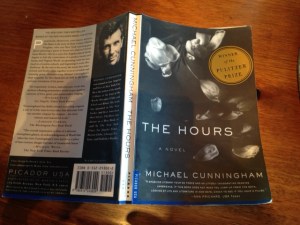
Serendipitous events: I went to a Q&A with author Michael Cunningham (at the Brooklyn Academy of Music) not long before my daughter began reading Virginia Woolf’s To the Lighthouse, not long before I found a copy of Cunningham’s Pulitzer Prize-winning novel The Hours (1998)—an homage to Virginia Woolf—at the lodge where I am now staying in Jackson, Wyoming.

So it seemed like fate: I was meant to reread The Hours.

This was a novel that everyone read and raved about, as I recall—it was The Goldfinch of 1998-99. But all I really remembered was that Virginia Woolf was a character. I’d forgotten why she was a character; I’d forgotten everything, in fact. Until I started reading, and I began to remember. One of the main characters is Cunningham’s version of Clarissa Dalloway, who, in the first chapter, is going off to buy flowers for a party. Later Woolf herself sits down to write the famous first line: “Mrs. Dalloway said she’d get the flowers herself.”

It’s one of few first lines I have never forgotten in all the years since reading Mrs. Dalloway in high school. It’s so simple, and at the same time so distinctive and yes, unforgettable.

In a very funny article Cunningham wrote in the New York Times in 2003 after The Hours was turned into a movie (remember Nicole Kidman with the fake honker, playing Woolf? And then winning the Oscar?), he describes talks about Mrs. Dalloway this way: “Woolf’s novel takes place in one day, during which Clarissa Dalloway, a 52-year-old London society hostess, shops, sees the man she might have married but did not, takes a nap, and gives a rather dull party. However, because it is an ordinary day in the life of an ordinary person as rendered by a genius, by the book’s end we understand that Mrs. Dalloway not only stands with the heroes of world literature but, by extension, that every one of us might stand so, if only a brilliant writer would look at us with sufficient depth and penetration.”

Cunningham makes me think I should be going back to his source of inspiration, but I’m happy to have The Hours in front of me. When his Clarissa centers herself in the moment, in her life, it seems like just right thing to be reading, as the spring we’re all longing for teeters on the edge of being.

“Outside the narrow kitchen window the city sails and rumbles. Lovers argue; cashiers ring up; young men and women shop for new clothes as the woman standing under the Washington Square Arch sings iiiii and you snip the end off a rose and put it in a vase full of hot water. You try to hold the moment, just here, in the kitchen with the flowers. You try to inhabit it, to love it, because it is yours….”

And the Book for the Ages is…

My 16-year-old daughter sorted through her old picture books last night, the dozen or so that are still in her room and not in cardboard box in the attic. I wish I could say she was in need of the distilled wisdom, or the simple joy, that a picture book can offer. No, she was on assignment. Vanessa is a junior, which means nearly ever waking moment is dedicated to schoolwork. She was looking for a childhood favorite to talk about in Spanish class. She considered A.A. Milne (the unforgettable When We Were Very Young and Now We Are Six) and the Narnia books. Then she found it. The one book to rule them all—hidden and lost, until now.

Barbie: The Holiday Gift.
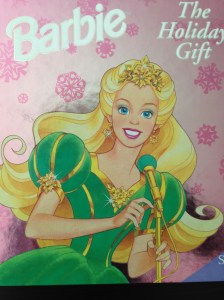
It begins like this.

One sparking winter day, Barbie hurried to the home of Mrs. Jenson, the town seamstress, to try on her gown for the Holiday Snowflake Parade. Barbie had been voted the parade queen, and her friends were the princesses. They were going to ride together on a float in the parade. “Your dress is almost finished,” Mrs. Jenson said, as she led Barbie into her sunny sewing room. “Oh, it’s lovely,” Barbie exclaimed when she saw the dress of rich, green satin. “I can’t wait to try it on.”

Barbie’s a queen of a girl, in more ways than one. Mrs. Jenson’s young niece, Laura, is shy, but she happens to have a beautiful singing voice. Barbie comes up with an idea: Laura could join her and her friends on the float and sing a song. In no time, she wins the mayor’s approval to go ahead with the singing (yes, the mayor has to get involved!), and the teens pool their money to buy fabric for a dress for Laura—pink velvet, no less. The ever talented Barbie designs the dress, which Mrs. Jensen makes in secret. On the day of the parade, Barbie surprises Laura with the dress and her idea. Laura is suitably thrilled, and ends up wowing the crowd with her voice. Laura can’t thank Barbie enough. She tells her:

“You not only gave me new friends, you helped me overcome my shyness. Those are the best gifts I’ve ever received.”

But Barbie has the last word.

“You gave those gifts to yourself, Laura, by sharing your voice,” Barbie replied. “And what’s more, you also gave all of us a very special holiday memory.”

Oh, so many special gifts!

I read this book over and over to a rapt Vanessa. So did her beloved babysitter, Carla, who gets the credit (no blame!) for buying the book.

The stilted language, the lackluster story line—Vanessa never noticed. She couldn’t get enough of those dresses. Oh, the dresses. Aside from Barbie’s blindingly green dress, there was Laura’s. That might’ve been Vanessa’s favorite. It had ruffled tulle-ish sleeves, gold ribbons and—gasp—a rose at the waist. Barbie’s four princesses also wore gowns on the float, each a different hue—pink, yellow, blue, and oops, another pink, a deep, dusty color that I can’t seem to find a better way to describe. Which was the prettiest? We pondered this endlessly. (Unbeknownst to her, I thought they ranged from hideous to only slightly less dreadful.)

“I think this book made me think about fashion for the first time,” Vanessa said, with only a hint of sheepishness.

Barbie, a fashion inspiration? I guess that’s not so hard to believe, when the person being inspired is all of four years old. Vanessa did not fall in love with Barbies, though. Not like I did. I spent years happily playing with Barbie and like dolls. Many experts argue that Barbie’s outrageous proportions give girls the wrong idea about what’s a healthy body size. That could well be. I don’t remember thinking about Barbie’s body—except to be amused that she had leg hinges where her butt should be. I didn’t care to see her naked; the whole point of having a Barbie was to dress her. My grandmother used to make clothes for my Barbie. (She wasn’t Barbie herself, actually; she was a brown-haired chick with bangs, quite pretty ’til I dabbed lipstick on her and the lipstick rubbed off, staining her face.) Putting clothes on, taking them off, putting something else on—it was all so deeply satisfying and enjoyable.

What I suppose I’m saying is: I had a positive Barbie experience, and my daughter did, too. As to The Holiday Gift: Now that Vanessa’s rediscovered it, I’m clearly going to have to save it for her. Who knows—it could end up being something she passes down to her daughter, this little board book, published by Fun Works in 1997. It’s still out there, in a small way. I found it selling for a buck, used, on amazon. There’s a whole new line of Barbie books, I see. Now she’s a modern-day princess with…super powers! And also a vet, a pediatrician, a teacher and a ballet dancer. I’d like to see Barbie the engineer, or Barbie the astrophysicist, or Barbie the head of Goldman Sachs. Perhaps I’ll find our Barbie book again when I’m, say, helping Vanessa pack her things to move to her first house. That’s got to be a good eight, ten years from now. We’ll see what Barbie’s up to then.
Mark Twain and the Bohemians

Recently I was lucky enough to meet Ben Tarnoff, the author of The Bohemians: Mark Twain and the San Francisco Writers who Reinvented American Literature (2014, Penguin Press). Ben happens to be my neighbor’s son-in-law, and he graciously agreed to meet with our book group. Bohemians is an engaging, colorful account of a period of American literary history that I for one knew nothing about. Ben focuses on the four best known San Francisco-based writers of the post-Civil-War period—Twain, Bret Harte, and the poets Charles Warren Stoddard and Ina Coolbrith (the first poet laureate of California). Twain and Harte wrote bold, irreverent California-based stories, fiction that was new and wholly American.

Now–I haven’t finished the book, and while I can highly recommend it based on the two-thirds of it I’ve read, I’m bringing up Ben because of what he said about the writer’s life–his own. I asked him if any part of the book had been especially difficult to write, and he said, “All of it.” He said he’d finish every day of work convinced the pages he’d just written were absolutely terrible. If he felt jazzed about what he’d written, he was sure to find it abysmal the next day.

A successful young writer (he’s also the author of A Counterfeiter’s Paradise, a history of the early years of the American financial system) doubting his abilities at every turn. What else is new, you say? True enough, but it’s always comforting to hear a published writer confess his or her insecurities. I almost felt a stab of pity: I feel good about my writing some days; I don’t think it’s awful every day! I almost got there, to the stab, but I only got as far as near pity. The fact is, whatever his method is, it’s working. His book is beautifully written (at least the part I’ve read is). And I look forward to his next work, whatever that may be—and good Lord, we didn’t even get around to asking him what he was working on.

The Iceman Cometh

I can’t last through a two-hour action flick without falling asleep at least once, but guess what—last night I was alert and engaged for the entirety of a FOUR-HOUR-LONG  play. Here I thought the problem was old age, but no! The relief of it—I just needed BETTER writing and acting! In this case, I’m got superior writing and acting in the form of Eugene O’Neill’s The Iceman Cometh, now playing at the Brooklyn Academy of Music.

it’s not an easy play to watch. A dozen or so drunks spend their days and nights at a bar in the Bowery (the year is 1912), using booze to disguise the hopelessness of their lives. Then their friend Hickey shows up and tries to help them get rid of their illusions—which only leads to more bitterness and despair. An incredible cast, led by Nathan Lane and Brian Dennehy. It’s not a flawless play—Hickey repeats himself so much it was distracting—but that seems like a quibble in light of its achievements. Another example of how powerful and enduring the best writing is.

Is it self-defeating to say I can’t hope to be as great a writer as O’Neill? I figure I’m not being self-defeating so much as realistic. The man won four Pulitzers and a Nobel, for crying out loud!  I have to point out that what I’m writing isn’t even eligible for such honors; I dream about a Caldecott.

Which reminds me: It’s time to get back to writing. Re-fueled, unexpectedly, by a spectacle of sheer hopelessness.

A Beef to Warm the Bones

How could I have forgotten about Liz Ann’s brisket recipe? It’s tender and smoky (you’ll see why in a minute) and utterly delicious, without or without a hearty roll or hamburger bun and BBQ sauce, but I recommend both. Good thing Super Bowl XLIX, or I should say the need to make food for my Super Bowl XLIX guests, led me to rediscover this tasty crowd pleaser.

Punxsutawney Phil is predicting six more weeks of winter. What else is new? We East Coasters (north of Washington, D.C., anyway) know that February is always cold and crummy, and let’s face it, much of March is, too. In other words, the time for brisket is now!

Liz Ann’s Brisket

1 brisket of beef, approximately 5 pounds
1 TB natural liquid smoke
2 tsp. salt
1 tsp. paprika
1 tsp. garlic powder
1 tsp. dry mustard
1 cup beef stock
Preheat oven to 325 degrees.

Combine spices in a small bowl and mix well. Brush brisket with the liquid smoke, then rub spices into brisket. Place meat in a covered Dutch oven and bake until fork-tender, about 3 1/2 hours. Begin checking after 2 1/2 hours; if natural juices have dried up, add the cup of beef stock.

Remove from oven. Cool slightly then cut meat into 2-inch strips. Using two forks, pull meat apart, Return meat to pan juices (you can add more beef stock if needed).

Serve on sandwich rolls with BBQ sauce. Great with cold beer. Makes 8-10 sandwiches.

As I gaze into the empyrean….

It’s been a while since I’ve run across a word that’s made me sit up and take notice. Here’s one: empyrean.

It’s another word for heavenly or celestial. It specifically refers to the highest reaches of the heavens, a sphere composed of pure fire or light, according to ancient and medieval cosmology, so says Merrriam-Webster online.

Empyrean. Em-peer-ee-an. Oxford Dictionaries online provides a list of rhyming words, most of which (oddly but amusingly enough) derive from Greek mythology or geography: Caribbean, Cyclopean, Fijian, Herculean, Sisyphean, Tanzanian…Oxford, how about just any word that ends with the sound “ee-an”?

Wiki tells me I’d know this word if I’d gotten around to reading Dante’s Divine Comedy.
Oh, well. As it happens I found this word in Anthony Doerr’s mesmerizing All the Light We Cannot See. At least I think I did—for the life of me I cannot re-find it, even though I’m sure it was used to describe the 133-carat diamond that is both a wonder in the novel and a wonder of the novel.

Empyrean. It can be used as a noun (the empyrean) or an adjective (and there’s also empyreal). I wonder if I can figure out how I can use it without sounding pretentious. Doerr can get away with it, because he’s a gorgeous writer. He doesn’t use many fancy words; he uses the right words. If you haven’t read this book, try to!

France and its Petty Problems (Joke!)

For anyone who’s interested, I’ve made progress on my resolutions! I’ve thrown out several stacks of old papers and board proceedings. It was easy, and so gratifying…I really have to do it on a more regular basis! I’ve also weeded out my closet, which was even more gratifying. After agonizing on this blog about whether I could really toss items like the skirt I wore on my wedding day and not since, the tossing was surprisingly easy. Something about writing it down—and then Lara wrote in her encouragement (thanks again, Lara!). My desk is still an utter mess, but at least now I can see all those other clothes that I forgot I had.Yes, I realize that if I forgot I had them then I haven’t been wearing them and should be chunking them, too, but I’m choosing to think these are blouses (mostly blouses, oddly) as new additions to my wardrobe. We’ll see how that works out.

It’s a gorgeous Saturday, I’m over the flu that laid me low for a few days, and I’m going to write. If I could just stop reading stories about what’s going on in France. I knew that anti-Semitism was on the rise in France—the odious National Front party, both anti-Semitic and anti-immigrant, gaining support—and I knew French Muslims were living the lives of an underclass, apart from real opportunity. I say “know” about these problems, meaning I’d read about them. Read about them, and forgotten them, as one reads and forgets about news stories all the time. And now the tragedy at Charlie Hebdo and the kosher supermarket have made all these issues painfully real.

As per a new anti-terrorism law, the French are now arresting and incarcerating people who make or post comments supporting terrorism—a guy who yelled support for the Hebdo terrorists getting six months. This is the wrong tack. I’m not against taking measures to criminalize hate speech, but throwing people who are likely just idiot loud-mouths into prison isn’t going to prevent further terrorist attacks. Muslims need improved economic and social mobility in France—that’s the longterm solution. I don’t know how much will there is among other French to give it them, though. The future for Jews in France is grim, too. French authorities say they can protect their Jewish citizens. Can they? Day in and day out? It’s surreal, the idea that they need to be protected at all.

Now I’ve got to get my head back into writing. Oh—first lunch. I worry about the world, but I’m also a master of procrastination.

Resolutions!

I’ve read that 40% of Americans make New Year’s resolutions. That’s it? Fewer than half of us? I admit I’m not as formal about resolution-making as I once was. As a kid U made a list of resolutions every year. I have absolutely no recollection of what those resolutions were, year after year, or how actively I set about meeting them, or if I meet any of them. They were probably boringly benign, like “Get better at ballet,” or “Write Grammy more often”—the kind of stuff that would withstand an accidental parental reading. I wouldn’t be fool enough to put in writing anything I desperately hoped for, like “Get a boyfriend,” the one wish that would consume my adolescence.(I was finally able to check that off the mental list when I was seventeen).

But writing something down can be powerful, and I’ve realized that years of not making formal resolutions have left me in a state of severe disorganization. In the interest of clearing my head for the important stuff (like being able to concentrate on becoming a better writer) I have to clear out the clutter that’s taken over every surface in my immediate vicinity. Piles of papers—clippings, financial statements, manuscript pages, old bills that need filing. It’s a morass I have been avoiding for… umm…years? I can hardly bear to acknowledge how long these piles have been accumulating! I have to get rid of them—asap! I can’t possibly take all year, or even all month.

Resolution #1: Read and file papers on chest of drawers. (Yes, it’s gotten so bad I have a pile next to my jewelry box.) Alternatively: Read and throw out papers on bureau.

Resolution #2: Throw away or do something with the stacks of papers, binders and books on the floor of my office. I’m super bored at the idea of going through them—but I’ve got to do it!

And then there’s the issue of the clothes clogging my side of the closet. Button-downs that seemed so useful at first and now look kind of dorky. (I think my shoulders are too rounded, or something). Sleeveless summer blouses that are too…sleeveless. The dress I bought online that is too revealing and I never got around to returning. (Originally I thought it might not be too revealing. Then I realized I couldn’t possibly wear it ANYWHERE unless I went into the escort business.) What’s the rule of thumb: Throw away anything you haven’t worn in two years? I’m paralyzed by the thought I will then have very few clothes—which is irrational, since I wear tend to wear the same jeans and t-shirts over and over again.

But there’s the question of sentimental value. What to do with that dress I wore at my sister’s wedding sixteen years ago but haven’t worn since? Wouldn’t it be a sort of betrayal to give it away? How about the red linen skirt that was part of my going-away outfit after my own marriage, twenty years ago?

The wheels are turning, rational arguments coming to the fore. It’s not like I’m throwing away my wedding dress—my modest New Year’s goals do not hide marital disarray. (Now that’s an interesting premise for a story, isn’t it? Under what circumstances—other than divorce—would a woman toss her wedding dress?)

Resolution #3: Throw out clothes not worn for two years. (Or most of them.)

I feel better already. Tomorrow I’ll get down to it. This month for sure. I mean it. IMG_1680

Favorite Fictional Orphans

I’m creating a character who’s parentless, a modern-day orphan. Her role models aren’t actual, real orphans (I don’t know any of those, a fortunate thing) but the long line of memorable fictional ones.

As a child I always cleaved to the orphans. Not because they’re free of parental constraints–just the opposite! I got heart palpitations at the thought of complete freedom from parents (no doubt because my parents were insanely controlling). That’s why I had to keep reading. I had to make sure these poor orphans were going to be all right.

Who are my favorite orphans? I know I’m forgetting a few, but this is a good start. In no particular order:

James, James and the Giant Peach, by Roald Dahl (as if there is any doubt who authored this). I wanted to reach into the book and hug James—and then adopt him. Who could not root for James, whose parents die in a freakish accident and who is forced to live with his horrible (if deliciously horrible) aunts before having the most extraordinary adventure (practically) in all of children’s literature?

Anne, Anne of Green Gables, by L.M. Montgomery. I loved Anne’s hot temper, being a hot-tempered redhead myself (and not recognizing a tired cliche). I loved her soulfulness, and her way with words. Of course, Gilbert kept me reading, too. Lucy Maud was clever to give Anne such an appealing antagonist.

Mary, The Secret Garden by Frances Hodgson Burnet). I didn’t like Mary, or this book, for many years. Mary was such a sourpuss! In that heartless way of children, I refused to give her break for being an orphan and alone in a strange, nearly empty house (these English and the way they ignored children!). But she grew on me, especially when she straightened out her whiny, self-pitying cousin, Colin.

Silvia and Bonnie, The Wolves of Willoughby Chase, by Joan Aiken. Bonnie isn’t an orphan at first, but for most of the book her parents are missing and presumed dead, so as far as I was concerned, this was the story of two plucky orphans. What these two have to endure! When Bonnie’s parents go on a long trip, they leave the girls in the hands of a cousin, who turns out to be an imposter, an evil woman who takes over the house and sends the girls to an orphanage. How are the girls to escape—and to where? I read breathlessly.

Bod, The Graveyard Book, by Neil Gaiman. Bod, short for Nobody, is anything but. He’s the kind of boy a girl can’t help liking—the kind of boy who would try to figure out a way to provide a headstone for a witch who was both drowned and burned. He has all kinds of ograveyard skills, like Fading and Dreamwalking, and is clever enough to take down the man who killed his parents. Which reminds me of someone else….

Harry Potter, of course, the most famous orphan of all time (sorry, Oliver Twist and Huck Finn). He’s the only character on this list whose quest is rooted in the brutal murder of his parents. He learns more about his dead parents than most orphans do, and with knowledge comes pain and regret. James and Lily Potter may be the only fictional parents whose loss I actively mourned.

My character will come to mourn hers, but she’ll also find unexpected joy. I’m a sucker for a happy ending.

Post Navigation