alexandra alger

ABC

A Deep, Painful Gratitude

Amid the outrage (justified in my view) in the Ferguson case, I am consumed by another death: that of a 16-year-old neighbor. The young man, brilliant and sensitive, took his own life on a Sunday night a few weeks ago. I know his parents, lovely and loving people. Their son I mainly knew as a kid on the block. I watched his growing up through glimpses on the street, on the way to and from school (he went to a nearby school, not far from the one my children attended). At last glimpse, he’d grown tall and looked very much a young man on the verge of adulthood. Off and on over the years I’d hoped he and my daughter might meet; incredibly, they share a birthday. But somehow they never did meet. Now they never will.

I had coffee with his mother just two days before that Sunday. I think back longingly to that sunny morning. We chatted about our kids, the way parents do, each expecting to have many such conversations in the coming years. Each thinking of the future in the brightest terms. When I saw his mother again she cried and hugged me and said the very thing that I was thinking: If only we could go back to that Friday morning. If only we could reset time. if only we could go back, and stop him.

I dreamed of this boy the other night. He was accompanying me somewhere. I didn’t know him in life, but now I’m dreaming about him. My unconscious mind has a lot to go over. I knew another boy who killed himself at the same age. This boy I knew. And I still mourn him, six years later.

Yesterday I paged through Joan Didion’s The Year of Magical Thinking to read once again her account of losing her husband when he suffered a sudden heart attack. It’s a powerful book; Didion helps me understand profound grief (horribly she would later suffer the loss of her only child to a baffling illness). The magical thinking of the title refers to her conviction that he would come back. She knew he was dead, and yet she was at the same time sure that he would find a way. She just wanted him back, so badly.

These are dark times now for these parents on my block. I wish I knew a way to bring comfort. There may not be any, for a while. Staying in touch, being a community, that would be something. Didion had a friend who brought her congee from Chinatown; it was the only thing she could keep down. Congee. I wonder if should try to find some.

For now, they are with family, in a different part of the country. Hopefully that’s a good thing. I’ll be with family, too, on Thanksgiving. This year, I feel a deep and pain-tinged gratitude for all that I have.
I’m Primed

At a ripe old age, I’m learning a foreign language, one that young women are naturally conversant in: the language of cosmetics.

I have absolutely no natural talent for this. My idea of makeup is lipstick, a swipe of mascara and a few dabs of a foundation to hide the blotches around my nose. But who am I kidding? Most days I’m the best I can do is slather Olay cream on my madly dry skin.

So this is my state of ignorance when I accompany my daughter, Vanessa, to Sephora.

What is she shopping for? Under-eye primer.

Under-eye primer. The words mean nothing to me. Turns out it’s a cream you put on before under-eye concealer.

“You wear under-eye concealer?” I ask. She’s all of sixteen, but she appears to believe she has circles under her eyes.

But back to the primer. It turns out that faces are like walls. The prime kinda does the same thing.

When you’ve entered middle age without knowing what primer for the face is, the news is not exactly earth-shaking. Still, in the spirit of the moment, I bought primer “lash builder primer,” by Clinique. “Conditioning undercoat boosts benefits of Clinique mascara, extends wear.” I have to say it sounded kind of great. Mascara never seems to last on my lashes; that’s partly why I rarely bother with it.

I can now smugly report that my mascara, combined with primer, lasts a full evening. Oh, baby! I actually had trouble getting the stuff off.

Naturally, I’m not getting too carried away. I know a woman does not need makeup to look and feel good about herself. I Girls shouldn’t feel they need it; but many do. it’s part of meeting cultural expectations. I’m part of a generation that said, f*** that, but this generation is different. They seem to find makeup empowering. I dunno, some girls definitely overdo it, and end up looking like 30-year-olds, but I figure there are more important things to make a stink about—like equal opportunity and equal pay for equal work. We have a ways to go there.

And while we’re getting there, I may need a good eyebrow pencil.

Pumpkin Tiramisu

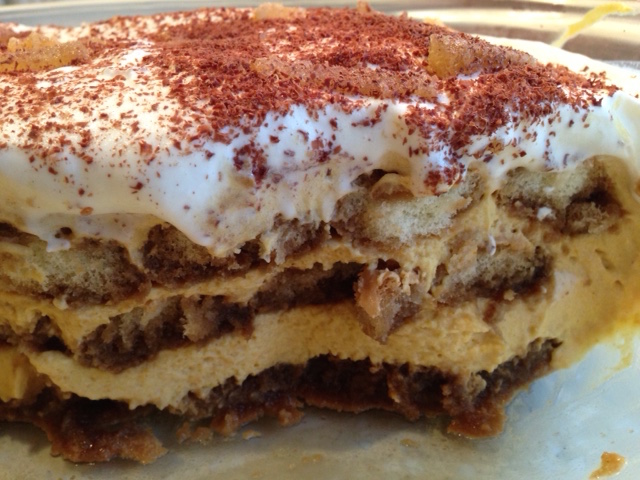
IMG_1391It doesn’t look as tasty in my Pyrex dish as it would in an elegant trifle dish, but this Pumpkin Tiramisu from  Food and Wine magazine’s Thanksgiving issue is a winner. It’s nearly as easy as pumpkin pie–easier, for those who don’t want to bake. I served to this to my book group, and nearly every woman wanted the recipe.

Pumpkin Tiramisu

45 min.; overnight chilling.

Serves 12

One 15-oz. can pumpkin puree

1/2 cup light brown sugar

3/4 tsp. ground ginger

3/4 tsp. ground cinnamon

1/4 tsp. kosher salt

Pinch of fresh nutmeg

3/4 cup granulated sugar

1.5 cups mascarpone cheese

2.5 cups heavy cream

2 cups brewed coffee, cooled

Two 7-oz. packages of dry ladyfingers

Chocolate shavings and candied ginger, for garnish

1. In a large bowl, whisk the pumpkin puree with the brown sugar, ginger, cinnamon, salt, nutmeg and 1/2 cup of the granulated sugar. Add the mascarpone and 1.5 cups of the heavy cream. Using an electric mixer, beat the pumpkin mixture at medium speed until soft peaks form; do no over-beat (getting to soft peaks too some time, more than I expected).

2. In a medium bowl, whisk the cooled coffee with 2 tablespoons of the granulated sugar until it dissolves. Dip both sides of six ladyfingers in the coffee and arrange them a single layer in a 4-quart trifle dish. Spread 1 cup of the pumpkin mousse on top. Repeat the layering 5 more times, ending with a layer of the pumpkin mousse. Cover and refrigerate the tiramisu overnight.

3. In a large bowl, using an electric mixer, beat the remaining 1 cup of cream with the remaining  2 tablespoons of sugar until soft peaks form. Dollop the whipped cream over the tiramisu, garnish with shaved chocolate and candied ginger and serve.

The tiramisu can be refrigerated for 2 days.

Listening to Betsy Bird

I had the honor of attending Pat Cummings’ children’s book illustration class at Parsons yesterday Not only did I get to see student writer-illustrators discuss the first pages of the stories they are working on, but I got to hear the down-to-earth-yet-droll Betsy Bird tell kid-lit publishing stories for more than an hour.

Betsy Bird writes a hugely popular blog for the School Library Journal, Fuse #8 Production, and is the city’s children’s librarian extraordinaire. She’s the New York Public Library’s Youth Materials Collections Specialist, which in plain English means she picks the children’s books carried at all the city’s public libraries. Wowza. And, naturally, she writes books. Her first picture book, Giant Dance Party, illustrated by Brandon Dorman, came out last year. She’s also co-authored, with Julie Danielson and the late Peter D. Sieruta, Wild Things: Acts of Mischief in Children’s Literature.

Betsy is a font of information, some of it rather mind-blowing. To whit:

It can take years to get a picture book published. Betsy’s manuscript was ready to go in 2009; it wasn’t in bookstores until 2013. What happened? For one thing, her editor left (or got fired), and the new editor made all kinds of changes. I can see how that could happen. Still: four years? That’s nothing, apparently. She’s heard of people waiting ten.

If Barnes & Noble doesn’t like your book cover, the publisher is more than willing to change it.

She hates horse books! If she’ve been wondering (as I have been) why the heck no one seems to be reading Black Beauty anymore, Betsy Bird is at least partly the reason. I knew why my daughter wasn’t reading horse books—she’s scared of horses, for no good reason, mind you—but I was wondering what had happened to the whole category….

If you’re writing for kids, you’ve got to get Betsy’s book. It offers up a satisfying trove of insider stories, as well as a meaty discussion on censorship and the obstacles that have faced and still face GLBT authors.

Boyfriend Jeans

My sixteen-year-old daughter went to her first day of school in her boyfriend jeans.

How’s this for the start a YA novel: “I went to my first day of eleventh grade in my boyfriend jeans. I don’t have a boyfriend, but I’m betting these jeans will get me one.”

Boyfriend jeans are a thing: loose, worn jeans that could be a boy’s, except they’re tailored for a girl. Vanessa’s pair are high-waisted, like ‘80s jeans you couldn’t pay me to wear again. She likes them high so she can wear skimpy tops without revealing her midriff, as per the school dress code. Clever; also lucky: She can wear any kind of jean, high, low, wherever. Me, I like jeans that just fit over my belly, providing gentle girdle support. Too high, and they squeeze uncomfortably. Too low—well, forget it.

Vanessa loves leggings, too. All girls seem to, these days. Remember the Sisterhood of the Traveling Pants? The first book came out thirteen years ago. Yes, that long ago! If it were written today, it might be named the Sisterhood of the Traveling Leggings.

Or maybe the traveling yoga pants. I happened to find an AP story, released just today, reporting that sales of jeans fell six percent this past year, while sales of yoga pants and other “active wear” rose seven percent. The story quotes a Scottsdale, Arizona high-school senior: “Yoga pants have replaced jeans in my wardrobe. You can make it as sexy as skinny jeans and it’s more comfortable.”

More comfortable, sure. I don’t know about sexy, or even….attractive. A site called girlsaskguys.com has posted a vigorous exchange of opinion on the subject. “Jeans hand down,” wrote one guy. “Unless they are being worn in a gym or in the privacy of ones [sic] home, yoga pants are god’s bitch slap to anyone with a fashion sense.” I agree, even though I don’t know what a bitch slap is. (I like the sound of it!). Another guy wrote, “Denim is too course [sic]. I like a girl to be smooth and soft including their clothes. Not that I go around feeling random girls’ pants or anything.” A third offered, “For sheer sexiness, yoga pants are fantastic. I don’t know why but it makes their butt so sexy.”

I hope my daughter ends up with a boyfriend who likes the boyfriend jeans. And knows grammar.

Nailing it

Querying: I used to think it was going to be no big deal once the time came. You tell the agent about your book in pithy, irresistible prose. How hard could that be?

Ha! I’m in revision hell. I’m finding terrible flaws in each query I sent out, but only a few days later. At the time of sending, it’s perfect: well written (pithy!) and error-free. But it’s an illusion. A day or two later, when I reread it in order to congratulation myself on my fantastic query, I’ll discover it’s stiff sounding, or sort of meh; or there’s a typo.A typo! In one query, I had two “I”s in the first sentence. How did I not see that before? I have no answer. There is no justification, no explanation. Well, there is one, and it’s obvious: I’m a nervous wreck about querying.

Get over yourself, Alex. I keep telling myself this. Who isn’t a nervous wreck about querying? I’m going to take a step back and give myself time to rewrite without pressure.

Then I’ll just have to go with what I’ve got, because I’ll reach a point at which I’m not making the query any better. It’ll probably be unintelligible at that point.

I really have to stop making typos, though.

Not the Worst Novel Ever Written

I finished my book. At least I think I have. And what makes me think so is I rewrote the beginning, and I actually like it. After countless, and I mean countless, revisions. Turns out I needed to come to the end to know how to begin.

Unless I’m deluded, and it really doesn’t work.

Argh!

Now that it’s time to send my baby out into the world, I’m wracked with doubt. Maybe it’s not ready. Does the plot build on itself, are there enough twists, do they catch the reader by surprise or do they seem forced? What crucial details about plot or character have I left out, having read and reread and edited and reedited so many times I’ve lost all objectivity?

My writing group of three talented women will not read another word. They want me to SEND IT OUT.

I’ll just have to wait and see what agents say. Or don’t say, since some of them (many of them?) only respond if they are interested in seeing more of your work.

I feel better when I remember former agent Nathan Bransford’s words from his newish book on how to write a novel: “You can’t possibly go and write the worst novel ever written. It’s already been done.”

Neil Gaiman, Live (Onscreen)

Neil Gaiman. Is there anyone more delightful to listen to talk about books? Somehow words like “delightful” come to me when I think of Gaiman. So English. Not that he’s necessarily so English—I’m mean, he’s English, but I don’t know if he’s one of those people you talk about as being “so English.” I digress.

There he was, live via video, talking from his home, about his favorite book, James Thurber’s “The 13 Clocks,” as a host of the Wall Street Journal Book Club. I can’t get over how he well he puts things. When one reader asked what his favorite passage was, he didn’t just boringly say, “Oh, I don’t have one.” He called the book a “giant favorite passage.” Don’t you love that?

I’d asked if any part of the book had scared him as a boy—the story is as dark as it is light—and he said no, because the narrator’s voice was so “comforting.” He found it scarier now, as an adult, he added. It’s funny how that can happen. I read Grimm’s fairy tales over and over at age six or eight. You couldn’t pay me to read The Little Match Girl or Bluebeard again. (For the record I was never so fond of the serial wife killer. Why is this a children’s story, by the way?)

Neil was insistent about 13 Clocks being a self-aware fairy tale, a metafictional work in which the characters know they’re in a story. I finally see what he means. In parts. I’m a bit slow, compared to Neil Gaiman.

If you’re a Gaiman fan, you can find the video Q&A at the Wall Street Journal’s blog Speakeasy: blogs.wsj.com/speakeasy.

Neil Gaiman and The 13 Clocks

Neil Gaiman has lured me into the Wall Street Journal Book Club. He’s chosen, as a guest book-club leader, James Thurber’s “The 13 Clocks.” In an interview with a Journal a few weeks back (where I learned about this book club), Gaiman said he’d loved this book since he was eight and some years back was flabbergasted to find it was out of print in the U.S. He offered to write an introduction if a publisher would reissue it, and in 2008 the New York Review Children’s Collection reprinted it.

I’d never heard of it. But who can resist a book that Neil Gaiman calls “like nothing anyone has ever seen before?”

“The 13 Clocks” is a singular fairy tale, published in 1950. (Gaiman says it isn’t really a fairy tale, even if it takes place in a fairy-tale world. Splitting hairs, surely?) There’s an evil Duke, who could not be more sinister, living in a castle where all 13 clocks have all stopped; a princess whom he’s keeping captive; a wandering minstrel (a prince in disguise) who teams up with a magical being, a Golux, to rescue and marry Princess Saralinda.

Thurber! He’s a master of making dark things funny. On page one, a description of the Duke, who is always cold and therefore always wears gloves: “He wore gloves when he was asleep, and gloves when he was awake, which made it difficult for him to pick up pins or coins or kernels of nuts, or to tear the wings from nightingales.” Wearing gloves to bed—silly, yes? I’m guessing the average kid would think so. And then a sensible list of things that are indeed hard to do when you wear gloves. And then at the end, like a punchline: A horrifying act—no, it sounds like more of a hobby, tearing the wings off nightingales, plural. Horrifying, and yet, because it’s unexpected, at the end of a list that’s otherwise banal, you (I, anyway) end up chortling at the incongruity.

And this: “The Duke limped because his legs were of different lengths. The right one had outgrown the left because, when he was young, he had spent his mornings place-kicking pups and punting kittens. He would say to a suitor, ‘What is the difference in the length of my legs?’ and if the youth replied, ‘Why, one is shorter than the other,’ the Duke would run him through with the sword he carried in his swordcane and feed him to the geese. The suitor was supposed to say, ‘Why, one is longer than the other.’”

Terrible that he’s kicking pups and kittens (no! I can hear a child cry), but for that to be the reason his legs are of different legs…I’m not even sure how to explain how that tickles my funny bone.Some animals lovers may, in fact, not find that part funny.

Gaiman makes much of Thurber’s language, and it is wonderful, alive and zany and mystical all at the same time. I’m not as enamored of his made-up words as Neil is—words like “zatch” for throat and “guggle” for stomach (or possibly the other way around.). The honest reason is, I’m feeling a sense of been-there-done-that because of Roald Dahl and books of his like “The BFG,” overflowing with hilarious made-up words (remember the snozzcumber?) I’m realizing now that “The 13 Clocks” predates “The BFG” by thirty-two years. Thurber should get the credit I’m giving Dahl. If only I’d read Thurber first!
Thurber turns language inside and out in the most delightful and unexpected ways. The Duke commands his men to take the minstrel to the dungeon: “Feed him water without bread, and bread without water.” Saralinda: He doesn’t compare her to a rose, but writes this: “It was not easy to tell her mouth from the rose, or her brow from the white liliac.” The Golux: “The Duke is lamer than I am old, and I am shorter than he is cold, but it comes to you with some surprise that I am wiser than he is wise.”

There’s a woman, Hagga, who weeps jewels. I’d forgotten about the vuluptuous joy of reading about jewels, masses of jewels, jewels in a big heap. I can’t even remember a story with a good heap of jewels. This may be the very best. Hilariously, Hagga can’t be counted on to produce precious stones, which the minstrel-prince must bring to the Duke. “Hagga laughed until she wept, and seven brilliants tricked down her cheek and clattered to the floor. ‘Rhinestones!’ groaned the Golux. “Now she’s weeping costume jewelry!’”

Have I convinced you to run out and buy “The 13 Clocks”?

In mid-July Neil himself will lead a live video discussion of the book. So I have two weeks to think of perceptive things to say.

Cereal: Does it Really Take Too Long to Eat?

People have been eating less breakfast cereal in recent years, according to the Wall Street Journal, and one reason is that it takes too long to eat. Yes, that’s right. “Cereal takes too long to eat during the morning rush and you can’t eat of bowl of cereal in the car.” That’s the Journal quoting various consumer surveys. I find this baffling. Since when is cereal-eating a slow activity? It just doesn’t take that long to pour cereal into a bowl with milk and scarf it down, especially if you’re trying to eat it all before it gets soggy (which some people don’t mind or even like, but I prefer my cereal crunchy to the last bite). This morning, I needed two minutes, twenty seconds, to enjoy a bowl of Wheat Chex. I wasn’t trying to save time. I read the paper, and I added extra milk at one point. Two minutes! Okay, closely to two and a half. Still, to really savor cereal, and perhaps add banana, we’re still only talking about five minutes. Five. Minutes. Obviously, no one wants to take time to sit or even stand for breakfast, once thought to be the most important meal of the day. (Some experts are now questioning this long held belief. I’d argue that whatever the evidence, breakfast is certainly more nutritionally essential than dinner, which all of us love but none of us need. A good lunch has got to be pretty important, too.) I love breakfast! The thought of hot coffee gets me up in the morning. Not the thought of showering, dressing, and driving to the McDonald’s take-out; no, I like stumbling down to the kitchen and making my own pot—ready in, say, five minutes. Coffee, along with yogurt and jam, or fruit (an apple quickly steamed with sugar and cinnamon!), that’s my favorite breakfast of late. But cereal is cool (Grape-Nuts: incredible crunch), and who doesn’t like toast? Especially with coffee? Eggs and bacon I reserve for the kids, the ones with the low cholesterol. One kid has one-upped me. She’ll prepare her oatmeal the night before and leave it in the fridge to get all creamy with things like almond milk and cinnamon (we like cinnamon in this family). The other has gradually come to realize that sleep takes precedence over food in the morning. He’ll probably end up being one of those people who rush out the door with a protein bar. Baffling.

Post Navigation