alexandra alger
ABC
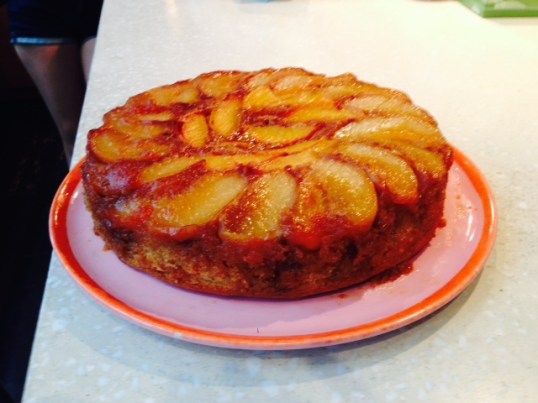
Let Them Eat Peach Tatin Cake
Have you been looking for a peach dessert that isn’t crumble or pie? I’ve got one! It’s Tish Boyle’s peach tatin cake from The Cake Book (Wiley, 2006). It’s peachy, it’s cakey, it’s caramel-y, and it comes out perfectly (or as near as anyone could want) even for baking tyros like me. The preparation is time consuming, I can’t lie, but only if you’re doing it alone. Enlist a sous baker, and it’s more than manageable. My sixteen-year-old, Vanessa, and I made this together, and we had it in the oven within an hour. PEACH TATIN CAKE Tish says it serves 8-10; I say 6-8, really 6, since everyone will want seconds. Ingredients: For caramel peach topping: 1 cup sugar 2 TB water 5 TB unsalted butter, cut into tablespoons 4 large peaches (recipe was divine with not-quite-ripe peaches, and even better, if a bit wetter, with ripe ones) For cake: 1 1/2 cups all-purpose flour 1 1/2 tsp. baking powder 1/4 teaspoon baking soda 1/2 tsp. ground cinnamon 1/2 tsp. ground ginger 1/4 tsp. salt 1 cup sour cream 2 tsp. vanilla extract 9 TB unsalted butter, softened 1 cup sugar 2 large eggs Prepare the topping: Position rack in the center of the oven and preheat to 350 degrees. Grease the bottom and sides of a cake pan and line the bottom with a round of parchment paper. The recipe calls for a 10”x3” pan; mine is 9.5”x2” and works fine. (Don’t use a springform pan, because the caramel is sure to leak out of it.) The recipe calls for greasing the parchment paper. I forgot to do this had no trouble getting the cake out of the pan intact later. In a medium saucepan, combine the sugar and the water and cook over medium heat, stirring until the sugar dissolves. I found I need to add at least twice as much water to dissolve the full cup of sugar. Once the sugar is dissolved, increase the heat to high and cook until the mixture turns golden brown. This can take a while, but once the darken begins, it proceeds quickly. Remove the pan from the heat and whisk in the butter, one piece at a time (the mixture will bubble furiously). Carefully pour the hot caramel into the prepared pan. Cut the peaches in half, then cut each half peach into six wedges. Arrange the wedges, overlapping them slightly, around the edge of the pan, on top of the caramel (which will be hard by this point). Arrange another circle of wedges in the center, facing the opposite direction, for a truly professional effect, until the caramel is covered completely. Make the cake: Sift together the flour, baking powder, baking soda, cinnamon, ginger and salt in a medium bowl. Whisk to combine, and set aside. In a small bowl, stir the sour cream and vanilla extract; set aside. In the bowl of an electric mixer, using the paddle attachment, beat the butter at medium-high speed until creamy, about 1 minute. Gradually add the sugar and beat at high speed until the mixture has lightened in color and texture, 2 to 3 minutes. Reduce speed to medium and add the eggs one at a time, beating well after each addition and scraping down the sides of the bowl as needed. At low speed, add the flour mixture in three additions, alternating with the sour-cream mixture in two additions, mixing just until blended. Spoon the batter in large dollops over the peaches and smooth into an even layer. Bake for 45 to 50 minutes (my pan only needed 40 minutes), until the cake is golden brown and springs back when lightly touched. Set the pan on a wire rack and cool for 10 minutes. Run a thin-bladed knife around the edge of the pan. Using pot holders, carefully invert the cake onto a cake plate. Peel off the parchment paper. Serve the cake warm (the best!) or at room temperature. Can be stored in an airtight container at room temp for up to two days or refrigerate for up to a week.
Anxiety dreams
I still get college anxiety dreams. Had two just in the last week. I never have exactly the same dream, but I’m always either late for an exam, for which I haven’t studied, or I suddenly realize, OMG, I haven’t been going to any classes and midterms are coming. In fact, wait–where are my textbooks? Why I get these kind of dreams, decades past college, is beyond me. I don’t remember collegiate life being all that stressful–at least nothing I couldn’t handle. What gives, subconscious? I’m guessing these dreams are protection against the source of my real-time anxiety, my writing, or more specifically this manuscript. that I am still fixing, several months past the deadline I’d set for myself. Things could be worse. I could be dreaming about agents rejecting me, or editors hating any manuscript I send. These are nightmares that could be all too real.
Kids these days, under more pressure than previous generations, are going to have much richer fodder for anxiety dreams. My poor 16-year-old, Vanessa, has been feverishly studying for a European history exam that’s going to include such questions as, “Compare and contrast all the wars of the 18th, 19th and 20th centuries,” and “How do social constructs differ from the 18th century to the 20th century?” She not only had to study all the major developments in Europe from 1400 on, but be prepared to tackle sixteen different short answer questions and a half-dozen essay questions.
I’m feeling grateful at how easy creative writing seems in comparison. Thank you, Vanessa! She should be out of her exam about now. Her work’s over; time for mine to begin.
What?!
I wish I could say I’ve been off this blog for three months because I’ve been on an insanely productive writing jag. And that’s true, in a way. Absorbed in completing my MG manuscript, getting it ready to send out, I kept putting off posting. And then I found I had blog writers’ block. Blog block.
Now it’s over.
Just as I’m finally, almost, about to be ready to query. I’m doing a final read-through. It’s taking far too long! Must-Get-Through. My writers’ group will kick me out if I don’t start sending it out asap. They are sooo over this manuscript! I sure can’t blame them.
Had to laugh at a comment Colson Whitehead made in his Q&A in this week’s NYT Book Review section. He’s asked,”What’s the one book you wish someone else would write?” His answer: “The book I’m working on now. Be a real time saver, and I could concentrate on my general brooding and sifting-through of my regrets.”
How I Got Turned On To Peyton Manning
Yikes, I’ve been out of touch for a bit, haven’t I? I spent January in a frenzy of rewriting, embellishing character, refining plot, all with the goal of finishing this draft by month’s end. And I’m not. I’m not! I keep telling myself, It’s okay, it’s okay, the important thing is to get this one right. This draft is really an amalgam of four or five, because the editing of one chapter tends to send me back to an earlier one, to make sure everything is fitting. Invariably once I look back on a chapter I see a word that isn’t quite right, or a phrase that sounds awkward, or a piece of dialogue that sounds off, and next thing you know every step forward means a step back. This is probably an inefficient way to revise. But it’s what comes naturally.
Enough of my revision angst. It’s Super Bowl Sunday! Like the other Americans who are not football fans–there have to be at least a few thousand of us in this country of 300 million–I’m mainly interested in the nachos. I have two bags of tortilla chips on my kitchen counter that I surely would’ve devoured by now save for the vision of nachos smothered in cheese and black beans, with a sprinkling of scallions, and guacamole on the side….
I’m off topic again. What I really want to say is, even though I rarely watch football I’m excited to see the game today, thanks to the Wall Street Journal’s Jan. 31 Superbowl coverage. Yeah, the WSJ–can you believe it? The Journal’s business writing has always been unparalleled, but in recent years it’s developed a flair for all kinds of other stories. The sports section drew me in with a front-page Super Bowl preview. The Journal cleverly used skier terminology to offer game perspective for three kinds of viewers: beginner, intermediate and advanced. I loved this! And I was pretty proud of myself for zooming down the intermediate run. (As in skiing, I had trouble negotiating the terrain of the black diamond.) Once I was inside the section, I saw an article with the headline, “Peyton Manning: Mr. Annoying.” Hello–really? Well, no–just a brilliant headline–but the story did turn out to be a fascinating, semi-humorous look at Manning’s relentless drive, an intensity bordering on obsessiveness that can get on his teammates’–and his coaches’–nerves. Writer Kevin Clark did what the best writers try to do: He made Manning human. You saw how a guy with his kind of talent becomes great–he thinks and works harder than everyone else.
You may be wondering, am I now a Peyton Manning fan? Am I going to root for the Broncos? Nope. I say, Let the best team win! Either way, those nachos are really going to hit the spot.
The re-vision process
This is my first post of 2014–this may be the first time I’ve written “2014.” Somehow I’m comfortable with the idea of this new year already, only nine days in; I was ready for it. This is the year I’m finishing my book. This is the year I’m finding an agent and a publisher. The penultimate sentence I type with reckless, relieved confidence; the latter, not so much confidence as hope. But that’s okay, first things first, one step at a time. I’ve got to focus, though. I’m close to finishing a revision that could be the last. I desperately want it to be the last. But I’ve got a haunting fear that I’ll read it through and find it wanting, that I’m facing a whole new re-vision.
I’m a perfectionist. It’s not a good trait for a writer, because perfectionists have trouble letting go. Kristen Lamb wrote on her blog a few days ago about knowing when to quit–when to put aside a manuscript, when to go on to a new project or even a new genre.
Deep breath. All right. I’m finishing up this draft this month and sending it to my two fantastic critique partners, Jodi Kendall and Gina Carey. Here we go.
Have Yourself A Merry Little Christmas
Christmas Eve. Decades out of childhood, years after my own children stopped believing in Santa, I still feel the thrum of anticipation, a sense that something exciting is about to happen. Some of this is the thrill of giving presents to loved ones (surely my teenage daughter will like that necklace?); and the undeniable pleasure of receiving presents (my son’s giving me the Nora Ephron collected works!); and the food, that’s huge. I’m making an eggnog cheesecake and a pear upside-down cake to bring to my sister, who’s hosting us all for a holiday meal. Taken together these are rich, gorgeous, extravagant displays of love that we don’t show each other any other time of year. Alas. I’m trying to love people more all year. I’m getting to an age at which I realize that I can’t be unthinking, thoughtless. I won’t have forever with the people I love.
Here’s what can only happen in New York on Christmas Eve. My husband Dan and the kids and i had dim sum at Nom Wah in Chinatown. We went there on a whim; we had no plans and couldn’t remember the last time we’d had dim sum. Nom Wah was new to us, but it’s been around since 1920. It was practically empty, to our intense pleasure. We sat down and ordered. Sometime between the soup dumplings and the pork buns, Vanessa started mouthing something to Dan and me across the table. “What? What?” Dan said. I shrugged helplessly. Finally we got what she was telling us: Jake Gyllenhaal and Maggie Gyllenhaal and their immediate family–their mother, Maggie’s husband Peter Sarsgaard, and their two daughters–had sat down next to us. Naturally, being a New Yorker, I didn’t look around. I know how to give movie stars space! I managed a casual glance to the left and saw Peter’s close-cropped salt-and-pepper head (poor guy–he’s losing his hair.) Standing to go I finally got a look at Jake in the mirror by our table. Jake, with hair to his shoulders and a beard. “Did he look hot?” My sister Nicole asked later. It was just the right question. And you know the answer.
Merry Christmas!
Getting Dialogue Right
In his recently published How to Write a Novel, middle-grade writer and former literary agent Nathan Bradford makes a key point about dialogue: Characters should speak more clearly and grammatically than real people.
Bradford writes: “In real life, our conversations wonder all over the place, and any conversation transcribed from real life will be a meandering mess full of free associations and stuttering. In a novel, good conversations are focused, and they are, for the most part, articulate.”
He’s right. If we had to read a character’s every “umm” and “you know” and “what’s that thing called again?” we’d lose interest fast.
It’s not as easy as taking out the umms, though. Especially if you’re developing middle-school characters, as I am. There is nothing more challenging than coming up with an authentic voice for each of my young characters. I want them to be well-spoken, but not too well-spoken. They can’t sound like mini-adults; they can’t sound like older teens, either. They have to sound like young people who are in the midst of growing up, still vulnerable but questing for independence and a sense of self. It’s a tough balance. Maybe this is why so many novels feature a verbally precocious kid who sounds like an adult. We adults love these kids–how could we not? They’re the ones who will actually talk to us, instead of grunting or ignoring us completely–and let’s face it they’re easy to create. Easier. Nothing about writing is easy.
Lurid, II
Author Michael Cunningham would raise an eyebrow at my recent off-the-cuff discussion of “lurid.” On page 7 of his 2011 novel By Nightfall, which I impulsively picked up at the Grand Central bookstore (how did I miss this back in ’11?), he describes “a white Mercedes canted at an angle on Fifth-ninth, luridly pink in the flare light.”
Right. I missed a meaning. So lurid can mean pale as can be, and it can refer to a color that glows in a disturbing way.
And now to move beyond the lurid lights of Cunningham’s accident, in which a car hits and kills a Central Park carriage horse. I wonder why a horse had to die. Terrible! Perhaps there a critique of the New York City horse-carriage business here, or the callousness of the moneyed classes. I’ll have to read on and see.
Hash!
My first turkey in years led to my first turkey hash in years. Damn, it’s good stuff! And there’s not much to it. I modified Julia Child’s recipe from The Way to Cook, taking out the veg (except for a handful of peas) and the cheese.
I’ve also managed to do a pretty good job on the leftover apple crisp and pumpkin cheesecake. I’m not the kind of person who can ignore two of the tastiest desserts in existence. Mysteriously, disturbingly, I’ve gotten little help from those kids, who are supposed to be growing and needing calories, for crying out loud.
Julia Child’s Old-Fashioned Hash:
Serves 4
2 cups boneless, skinless cooked turkey, cut into small pieces
2 cups of diced potatoes
1 cup diced onion
1 TSP fresh lemon juice
2 tsp. minced fresh thyme
2 TB butter
2 TB olive oil
2 TB flour
1 1/2 cups hot liquid (milk, chicken stock, gravy; I used stock)
2/3 cups diced vegetables (peas, carrots, broccoli;I used frozen peas)
2/3 cups grated cheese (Swiss, cheddar, Monterey Jack or mozzarella)
salt and pepper to taste
In a bowl, toss the turkey with the lemon juice, olive oil, and thyme; set aside.
Peel and dice the potatoes. Drop them into a pot of lightly salted water and simmer, 5 minutes or so, until barely tender. Drain.
Saute the onions slowly in a 10-inch frying pan with the butter until tender. Raise heat slightly and brown lightly, about 10 minutes. Blend in the flour; cook, stirring for 3 minutes. Remove from heat and blend in one cup of hot liquid. Simmer, stirring, for two minutes. Season with salt and pepper.
Fold in the potatoes, turkey and the peas, and the remaining hot liquid. Cover the pan and simmer slowly, uncovering to stir occasionally, until the potatoes are tender and you can’t wait to eat any longer! That was about 10-15 minutes for me; Julia likes to keep it simmering 35 minutes, adding liquid as necessary, and then adding cheese and cooking uncovered until the bottom is browned and well-crusted.

 alexandra alger