alexandra alger

ABC

Archive for the year “2015”

Here’s to 2016

I love the holiday season. How festive the city is, ablaze with Christmas lights, both ethereal and gaudy, Balsams greening up street corners, shops bright and busy. I thrive on the chaos the season brings. It’s a delicious kind of stress, the only good kind I can think of it—the mad scramble to find gifts and get the holiday cards out and plan the Christmas lunch. Every year I wonder how it all gets done, and it always does. This year, for the first time in memory, I got all the presents wrapped before Christmas Eve. It was fantastic to not be up at midnight, blearily trying to masquerade the ends of a Lego set with what’s left of the wrapping paper. And the years of trying not to slip up and wrap Santa’s gifts in the same paper as Mom and Dad’s! (Nothing got by those kids— they were quick to point out if Santa had the same wrapping paper, challenging me to admit something I never would and never will. You’ll never heard me say I don’t believe in Santa!) This probably sounds either pathetic or crazy to those of you who get your holiday shopping done byThanksgiving. I have met a few of your number, so I know you actually exist. I can never hope to be in your company, O otherworldly ones!

And now it’s coming to end, once again, and 2015 is nearly over. Oddly, I feel as if 2016 is already here. I’m lacking my usual, roll-up-the-sleeves, I’m-gonna-do-it-all sense of resolve when facing a new year. Is it age? Am I just at the point at which time, as meted out in human-ordered increments, has no meaning? Is it just that the number six doesn’t look so different from the number five?

Partly to blame, now that I’m thinking about it, is the state of the world. It’s hard to look ahead with optimism when there is so much to worry about. When and where terrorists will strike. The plight of Syrian and other refugees, short and long term (Germany alone has taken in nearly a million so far and pledges an open door—but can it house and find jobs for so many? Can and will they all assimilate?) At home the appalling slate of Republican candidates. If any one were elected, we wouldn’t be living in a country I recognize (Kasich would be okay, but he doesn’t seem to gaining any traction). Hillary better win. She’s going to, she’s got to. She must.

The world’s problems are taking some of the fizz out of my champagne, but not all. I’ve got resolutions, I’ve got ‘em. Some of the usual suspects are on the list, of course (i.e. reduce ice-cream, red wine consumption; get an agent, get published, etc.) Here’s a new one: I want this latest novel I’m working to be really good—objectively, no-doubt-about-it good. I tend to like my own writing, but I know when things aren’t entirely right—the plot’s going limp, a subplot isn’t jelling, voice is off. So self: Let’s pull it all together this year! And here’s to excellence in your work, fellow writers!

When the Real World Intrudes

I didn’t get a lot of writing done this week, glued as I was to reading about protests and discussion about racial discrimination at Yale, my alma mater. I learned that many students of color are subject to racial slurs and comments that other students—and faculty members!—don’t even seem to realize they’re making. I learned that black women in particular feel that Yale isn’t theirs and doesn’t care about them. I couldn’t believe what I was reading at first; the Yale I knew was a place of equality and respect for everyone, regardless of background, gender and race. Wasn’t it? A stream of Facebook comments, blog postings and articles by African-American alums and current students let me know how clueless I was. Powerful, frank and true words from Roxane Gay in the New York Times today:

“There is a degree of safety members of certain populations will never know. White people will never know the dangers of being black in America, systemic, unequal opportunity, racial profiling, the constant threat of police violence. Men will never know the dangers of being a woman in America, harassment, sexual violence, legislated bodies. Heterosexuals will never know what it means to experience homophobia. Those who take safety for granted disparage safety because it is, like so many other rights, one that has always been inalienable to them. They wrongly assume we all enjoy such luxury and are blindly seeking something even more extravagant. They assume that we should simply accept hate without wanting something better. They cannot see that what we seek is sanctuary. We want to breathe.”

Even as I was reading these words,  the terrorist slaughter in Paris (a lack of safety on another order entirely) was distracting me. My husband Dan and I have passed much of the last two days watching updates on T.V. (Count of the dead up to 132.; attackers being traced to an impoverished Brussels suburb.) It seems to me the French authorities have worked exceptionally fast. They have already pinpointed members of the terrorist group who are still at large, including a French citizen whose photo has already appeared so frequently I think I would actually recognize him if I saw him. (To be the one to bring him in—what a thought; the stuff of fiction!)

In Paris, schools, museums, the Eiffel Tower, all will reopen tomorrow. The French will leave their homes and try to go about their lives once again. We New Yorkers who lived through 9-11 understand their fear. We lived it. We survived, and they will, too. And working together the world’s major powers will dismantle ISIS. I have to believe they will.

Ghoulish Fun

IMG_2278Not bad, eh? “Traditional,” my daughter commented. I didn’t pay her any mind. It’s the best carved pumpkin we’ve probably ever had! My husband Dan deserves the credit for the carving (based on a drawing we found online under “pumpkin faces.” Thank you, internet!). Somehow I was able to cajole him into doing it, while I stood by and watched. Is this ever the way to go–carving that baby the weekend before! So much more enjoyable than the the routine established after the kids lost interest in the pumpkin (and Halloween decorating in general): I’d put off the carving until Halloween day, until about, oh–an hour before the trick-or-treaters were due to arrive. The pumpkin, after a few weeks’ on the stoop, would be old and tough and resistant to the tiny saw from the pumpkin carving kit.  I’d default to the most basic pumpkin happy face, the one with triangle eyes and the gaping grin. Then I’d rush, rush, rush to throw a witch’s wig on, spread black makeup on my face (if I have time, black wax on my teeth–it really freaks kids out) and dump the candy into the big ceramic bowl that only comes out on Halloween. I sound like a pathetic whiner and procrastinator, don’t I? No more whining, from this day forward. Because now my talent husband’s in charge of the pumpkin. “Honey, you did such a good job last year, you have to do it again,” I’ll say this time next year. And he’ll have to agree.

Food in Kids’ Books

The MC in my new manuscript likes food. It’s not her defining characteristic or anything, but she lives in Brooklyn, New York’s foodie-est borough. You have to try really hard (or be a two-year-old) to avoid good food in Brooklyn.

Middle-grade characters known for a food they like or dislike: It’s a rare breed. There’s only one character who pops into my head immediately: the grumpy, quirky heroine of Harriet the Spy, who ate a tomato sandwich (white bread, mayo) for lunch every day. When I read Harriet back in the day, I was as revolted as author Louise Fitzhugh probably wanted me to be. Tomatoes were like lettuce to me: watery, tasteless. What was the point in eating them? There were no organic Heirloom tomatoes trucked in from upstate farms in the 1960s, when Harriet the Spy was first published, or in the ‘70s, when I was growing up.

Then there’s the poor giant in Roald Dahl’s The BFG, who subsists on snozzcumbers, probably the foulest vegetable (real or not) in children’s literature. Sophie the orphan can’t even swallow one bite. “‘It tastes of frogskins,’ she gasped. ‘And rotten fish!’ ‘Worse than that!’ cried the BFG…’To me it is tasting of clockroaches and slimewanglers!’” (I looked that up, in case you were thinking I had amazing recall.)

There may be others. Overall, though, I’d say that food has not been a big motif in kids’ books for the simple reason that it hasn’t been a big focus for kids. It can be a source of enjoyment (Yay, pizza!) or conflict (Mom insists you eat breakfast, but you’re late for the bus; a mean kid at school makes fun of your lunch). But traditionally—both in life and fiction—eating is something done in between activities; it’s not an activity in itself.

That’s changing a bit. Kids are way more sophisticated about food than they were even ten years ago. More and more, they have tastes that span the globe. They eat fish tacos and Bánh Mì pork sandwiches and sushi and Pad Thai. Last week, the Wall Street Journal published a story on the American child’s expansive palate. According to the Journal story, households with children under 18 are twice as likely as households without children to have eaten Korean, Indian, Thai, Hispanic or Caribbean in the last three months.

Have children actually become more adventurous eaters than their parents? That would be quite an extraordinary thing. If the Journal is onto a real trend, I’m guessing we’ll see increasing numbers of fictional characters with foodie sensibilities.

We’re already being introduced to a few characters who know their way around a kitchen. Gladys Gatsby, the protagonist of Tara Dairman’s Four Stars (2014), is a budding chef; Moses LoBeau, of Sheila Turnage’s Three Times Lucky (2012), steps in when needed to run the breakfast service at Miss Lana’s café (she comes up with a menu she can handle—“a full line of peanut butter entrées”). A kid chef with a TV show—that’s coming next. I’ll be looking for it.

GoButler, Chapter 2

Update on GoButler, the free text-based butler service I joined a few weeks back:

If you read my original post, you know that I was put on a waiting list for my “butler.” Eleven days later, I got a cheery text: “Hi and welcome to GoButler! 🙂 I’m Ian—what can I help you with today? I can order food, make reservations, book travel…whatever you need!”

Naturally, I sent back a cheery hello and a I’ll be in touch soon. Funny thing was, with my husband’s birthday out of the way (it was a big success—I’m off the hook for another year), I couldn’t think of a task for Ian. Order groceries for delivery? Giving a list to Ian to give to some delivery service is more work than my doing it myself (Freshdirect couldn’t be easier). Order take out? I suppose I could say, “Ian—one order of Massaman curry, thanks!” but that would go against the grain. Like many New Yorkers, I have my usual places I order from; I don’t want curry from just anywhere. I suppose I could ask Ian (Eloise-like), “Please order me Massaman curry from Café Chili on Court Street, thank you very much!” But….am I really so busy that I can’t call Café Chili myself? Honestly, I’m not too busy to call myself.

So I didn’t contact Ian right away. A few days went by. He must’ve guessed I was at a loss. Or maybe he just needed something to do. He sent this: “It’s Wine Wednesday—let GoButler get you some nice old grape juice, some cheese, and help you unwind. Let me know if you’re interested and I’ll get started! :)”

I was charmed by his idea—wine and cheese! I happened to be in St. Louis last Wednesday night, but I suggested I might order some wine for Friday night. A rosé, for toasting the final days of summer.

But what bottle, exactly? This would not be an issue if I were stopping by the neighborhood wine shop. I’d swiftly choose a bottle in the quasi-random way I usually do. I could’ve asked Ian for advice, but that seemed risky. I suggested a Sancerre rosé, about twenty bucks, which I remembered having earlier in the summer and liking.

I asked where Ian was going to shop for the wine, and he told me GoButler used an online service called MiniBar that checked pricing and availability in stores around me. So far so good, but then guess what—Ian informed me that Minibar had a minimum of $25 for a delivery.

Ha! There it was, the catch: If you want your butler to order you wine, you gotta spend at least $25. I couldn’t offhand think of a $25 bottle of wine, so I added an Albariño to my order. Total spent on my GoButler experiment: $40 (which I paid through a link GoButler sent me, connecting me to PayPal).

The wines were really nice. I suppose I could see myself texting Ian some Friday to send over another bottle of that rosé. But I think I’m much more likely to stop by my local wine shop.

It seems clear that for GoButler to succeed, people like me have to order frequently and spend more money than they might otherwise spend. I may not be the ideal client, but Ian may get a bit of work from me yet. I wonder if he knows who gives the cheapest facials in the ‘hood?

Oh, Jeeves….

I know there are all kinds of apps out there that will do almost anything for you, but I’ve never gotten on the bandwagon until now. GoButler (gobutler.com) is text-based and free. You sign up on the website—by which I mean, you type in your cell phone number—and you’re on the way to getting your own Jeeves. For the cost of whatever it is that you ask for, your butler will deliver sushi, make dinner reservations, find theater tickets, arrange travel, and, theoretically, do anything you ask, as long as it’s legal. (The website specifically mentions this. Think how big GoButler’s pot-delivery business will eventually be!)
My daughter, Vanessa, is the one who discovered GoButler a few days ago, and when she told me about it I understood in a flash we urgently needed a butler. Why? My husband’s birthday is coming up. He’s one of those guys who actually buys stuff for himself. Clothes. Gadgets. Shoes. Underwear. (Really nice underwear, too.) But he also happens to love presents, especially on his birthday. You can see where such a situation leaves me: First, in a state of denial, which leads to lengthy procrastination. Then panic, and a burst of random shopping a few days before the birthday, August 18, ending in the purchase of the first nice shirt I find. This year, I’ve managed to find a short-sleeved button-down with a cool gray water pattern—perfect for casual Fridays, yes?—and a sophisticated navy button-down that was frankly a panic buy, but he really could use a navy shirt, I’m sure of it.
But when Vanessa looked up for her computer with the news about five-month-old GoButler, and its phalanx of eager-to-please, one-text-away personal assistants, I saw a game-changer. I imagined Dan, thrilled beyond measure at receiving a fantastic birthday present; a present I didn’t have to find. “I could ask for three suggestions for cool gadgets for a fifty-year-old who thinks he’s a hip thirty-year-old,” I said happily.
“And they could tell me what I could get him for under forty dollars,” Vanessa added.
She signed up immediately; I figured there was no need to be greedy; we could share a Jeeves. And that’s when we learned the catch: The service is so popular there’s a waiting list.
Rats.
I see the silver lining, and it’s a thick, bright thing: If Vanessa is assigned a butler sometime this fall, I can get him or her working on Christmas-gift ideas.
A terrible thought just came to me: Is it possible coming up with gift ideas isn’t on the list of butler services? Say it ain’t so!

Agatha Christie and the Color Puce

What color is puce?

I haven’t read or heard the word “puce” in ages—possibly not since childhood, when children’s books were full of orphans dressed in hand-me-downs that were some drab color—if not brown, then gray, or…puce! I feel sure I bothered to look up the exacting meaning; it was so obviously an ugly color, just from the sound of it. Phew! with an “s” at the end.

Then again I may well have first encountered the word in Agatha Christie’s 1972 mystery, Elephants Can Remember, which I just unearthed and am happily rereading. The book opens with mystery writer Ariadne Oliver considering a hat to wear to a luncheon. The hat she chooses is a “kind of turban of various layers of contrasting velvets, all of rather becoming pastel shades which would go with anything.”

I can’t for the life of me imagine how such a hat could go with anything at all. Anyway. The main point is, she pairs the turban with a wool dress “of a delicate puce color.”

There it is. Puce. A color that apparently can be “delicate” or—presumably—vibrant. And might (though my faith in Mrs. Oliver’s taste is now shaky) go with a number of other colors. Mrs. Oliver mentions the colors in her hat —green, blue, red and chocolate brown (Why Mrs. Oliver calls the latter two pastels is beyond me.) There is no way to guess, based on this welter of info, what color this wool dress is.

I look it up, and it turns out there is some disagreement on what color puce actually is.

Grayish pink? Light green? Maroons brown? All these shades pop up online as puce. And that’s not all. It’s “dark purple brown,” or a “brownish purple,” asserts that eminent source, the OED, which obviously has two constituencies to please, those on the side of purple, and those who insist on brown. This is one strange, and let’s face it, ugly, set of possibilities.

Who would set off such a debate? The French may have that dubious honor. Puce is the word for “flea” in French. That’s right: Puce literally means flea-colored.

Oh, the French and their love of fleas! They use “puce” as a term of endearment, such as calling a child “mon petit puce” (my darling little flea). “Flea market” is a literal translation from the French for a market that sells second-hand goods likely to be flea-infested. Personal hygiene being low on the list of priorities in past centuries (even until recent decades, some may argue), I’d wager that the French have a long, intimate history with fleas.

A historical novelist named Catherine Delors avers that France’s King Louis XVI—the one who met his end at the guillotine in 1793, along with his infamous wife, Marie Antoinette—coined “puce” to describe the color of one of his wife’s favorite gowns. On her blog Versailles and More, Delors has a picture of a scrap of this gown, put up for auction at Christie’s a number of years ago. It looks to be a light brown, what I would call the color of dark honey; banal, as royal colors go, and certainly not dark purple brown. Had it perhaps faded or gone through some sort of change over the course of two hundred-odd years? (This question may not have bothered the buyer of the scrap, who paid $76,000 for it, according to Delors.)

Can a flea be a variety of colors? A site called fleabites101.com says there are about 2,000 different kinds of fleas around the world, so maybe so—though this source says they are brown or reddish brown and doesn’t elaborate. I have to admit that I’ve been lucky enough never to have seen a flea up close. On another site, I found pics of a cat with fleas—and believe it or not, they were light brown. Louis XVI might’ve been a connoisseur of cat fleas.
Still the question lingers: What is the color of Mrs. Oliver’s wool dress in Elephants Can Remember? If only Agatha were still alive. What was puce to Agatha Christie in the early 1970s?

If we start with the assumption that Agatha has given Mrs. Oliver a modicum of taste—the unfortunate turban aside—green might be the color: a pale green, not quite pea but close. Louis’ brown might work, too. It’s probably not dark purple brown, but it could be a lavender with a hint of beige. Pink is out, unless Mrs. Oliver were one of those women who liked pairing red and pink.

Oh, well. There’s no way to know. Agatha has unthinkingly created a small unsolved mystery. The only conclusion about puce I can make is what I knew at the start—it’s probably hideous. Except one: The one true essence of puce, we can say, is it’s a Vomitous might be another word for it. Might Marie Antoinette have kept her head had she not been fond of puce?

Into the Woods

I spent the last two days and two nights without wifi or cell-phone service (or land-line service, either).

You’re wincing, aren’t you? You’re trying to imagine being out of range for one day; half a day; a few hours. I was the same way. I was really kind of dreading this trip. I was sure something terrible was doing to happen, and I wouldn’t be able to get help in time.

Where exactly was I? My husband Dan and I stayed in a hunting lodge on a lake in the Adirondacks. On a pristine body of water called Boreas Pond. The property is part of a 161,000-acre tract that the Nature Conservancy purchased from a local paper company and is in the process of selling to the state of New York as protected public land.

Dan is head of the board of the New York State chapter of the Nature Conservancy. That’s the kind of volunteer job that leads to a chance to spend two days magnificently alone in the Adirondack wilderness with your wife. Alone in this case meaning seven miles of dirt road away from other humans (and cell-phone service).

I was awed at the thought of such isolation, even as it gave me acute anxiety. I was channeling Woody Allen. There I was, marveling at the beauty of the lake—in color nearly black, from tannins—and at the same time having visions of disaster, principally: Dan having a heart attack on a trail. A bear, mauling him. A strange upstate bug giving him a serious allergy attack (He gets horrifically large bug bites). I can’t tell you my relief when a TNC staffer showed me the satellite phone and and a kind of emergency pager connecting us to rangers who would descent on us like ants on a picnic.

So we’d be all right. We had life lines. But what about bears? Moose? Snakes? Mike Carr,
head of TNC’s Adirondacks chapter, assuaged my fears. Bears—he couldn’t remember the last time he’d seen one. Moose—not interested in humans. Snakes—no poisonous ones, anyway. I started to relax. A little. Then a bit more.

After a turkey sandwich and a Shiner Bock on the front porch, clouds rolled in. When the rain began, our choice was clear. We stretched out on the leathery hunting-lodge couch and napped. It was delightful. I can’t remember the last time I took a nap in the afternoon. Who has time? There, we did.

We had the time to paddle on the lake and consider that we were the only humans there. I imagined I were a native American, surveying the forest where I would late hunt white-tailed deer. The Last of Mohicans, with Daniel-Day Lewis, was filmed in the Adirondacks. Remember how DDL ran in the woods, swiftly, gorgeously, his hair flowing behind him? The film crew had to have bushwhacked a path for him. There’s just no way he could’ve run in these woods. We didn’t even try to walk in them. The pines and aspens and fir trees (and others) compete for how closely they can grow together, and whatever space remains is clogged with dead branches and stumps. (Kudos to the hunters, who come in the fall to shoot deer. I don’t know how they get through the thicket. I’m not sure how the deer do, either.) We hiked up a dirt road that was once used as a logging route, wondering what creatures might be hearing or seeing us. We saw moose and deer tracks, but the creatures themselves kept their distance.

When did more reading than we usually do. Dan inched closer to finishing David Foster Wallace’s behemoth, Infinite Jest. I devoured two 1950s paperback westerns I’d picked up for 50 cents each at a local store. We talked—or didn’t. When you have all kinds of time to talk, you find you don’t always need to. We made burgers and drank beer and struggled to stay awake long enough to see the stars in a sky without any ambient light. (We missed out; a night haze obscured the stars.) When we rolled onto the paved road and the bars on my phone appeared, I felt a pang of regret. A life without the unending buzz of texts and calls and emails: It was wonderful.

Summer Ease

IMG_2015

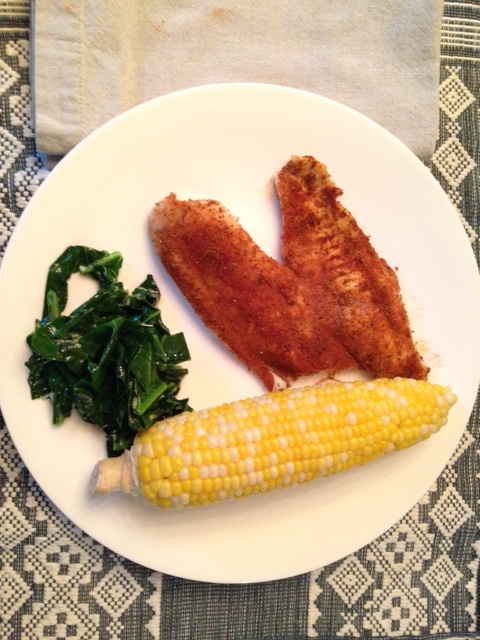
I had fresh corn for the first time this week. Heaven. I live for fresh corn. I can’t get enough of it. I gorge on it all summer, and then suddenly, just as the air grows chillier and the corn kernels harden, I find I can’t stand one more ear. I’m ready for turnips and cauliflower.

I haven’t posted a recipe in a while–just haven’t been inspired in recent months–but the arrival of corn at my local markets has gotten me fired up to share this incredibly easy, fast and delicious tilapia recipe, served with steamed corn and collard greens stir-fried with garlic and olive oil.

Sheila Lukins’ Tilapia (from cookstr.com, slightly amended)

Yield: Serves 4

Ingredients:

Spice mixture:
1 tsp. salt
1 tsp. sweet paprika
½ tsp. ground cumin
¼ tsp. Old Bay Seasoning (I’m not entirely convinced you need this)
¼ tsp. garlic powder
¼ tsp. dried thyme
¼ tsp. dried oregano
¼ tsp. dry mustard (I don’t use if I don’t have)
¼ tsp. freshly ground black pepper
¼ tsp. cayenne pepper (I don’t always use this, either)
Pam cooking spray
4 tilapia fillets (about 6 ounces each)
4 lime halves, for garnish

1. Preheat oven to 400 degrees

2. Prepare the spice mixture, combining all the ingredients in a small bowl.

3. Coat pan with Pam spray.

4. Spread fillets with the spice mixture on both sides. Spray top of then fish with Pam.

5. Bake for 1-12 minutes, until the fish flakes.

6. Serve immediately, garnished with lime halves.

I have to share this recipe, too, because it’s the dessert equivalent of the Tilapia dish–no, it’s even easier you don’t have to worry about whether you have Old Bay seasoning or if you remembered to buy dried mustard. As long as you have a pint or two of blueberries around, or a few fresh plums–both so plentiful in the summer–you can make this last minute. It’s so easy you won’t believe it actually tastes good. The fruit melts into a crusty, buttery cake. It’s even better for breakfast the next day. My friend Ellen Newman, a Cobble Hill, Brooklyn, neighbor, is the genius behind it.

Ellen Newman’s Fruit Tort

Ingredients:

I cup flour

I cup sugar

1 stick of salted butter, melted

1 tsp. baking powder

2 eggs

Pinch of salt

A couple of plums, peeled and sliced; or two pints of raspberries; or one-two pints of blueberries.

You’re wondering about milk, aren’t you? Nope. There’s no milk involved. No other liquid–just go with it!

1. Preheat oven to 350 degrees

2. Mix together everything but the fruit in a greased and floured springform pan.

3. Gently put fruit on top.

4. Bake for 45 minutes to an hour, until the top is golden.

Write me if you try this. I need to know that despite your reservations about how this could possibly turn out, it did, and you were thrilled.

Inspiration from Rafa Nadal: Fight!

I’ve been glued to the French Open this week. ESPN and Tennis Channel make watching live tennis from around the globe just so easy. Too easy. And I’m so weak! I could’ve taped matches and watched them after writing hours. Of course I could have. And I clearly have to develop some discipline before Wimbledon begins in a month. I admire the red clay and the gritty play of Paris, but I love the elegance of grass courts and players all in white (and it is kind of fun when the camera finds a royal or two). I remember the days when Roger Federer ruled the grass, and he’d appear on Centre Court in a crisply tailored white jacket that he wore solely for that walk to his chair before his match.

Yesterday, with my computer in front of me, patiently waiting for my attention, I turned on the Rafa-Djokovic French Open quarter final. There wasn’t much to watch, sadly. Rafa Nadal, the King of Clay, who has won a record nine French Open titles, was trounced in straight sets.

Shocked? Yes. Surprised? No. Most commenters had been expecting Djokovic to win. Nadal has struggled in recent months. He didn’t win even one of the clay-court tournaments that he usually dominates and has dominated for nearly a decade. Then again, he’s got good reasons for not being at his best. He had an appendectomy at the end of last year, and has been dealing with back, wrist and knee issues.

Some commenters have already declared him past his prime. They aren’t saying his career is finished, but coming awfully close. It seems to me that anyone who’s watched Rafa for any length of time would know that he is nowhere close to retiring.

He just took the biggest beating of his career (arguably), and what does he take from it?

This is what he said after the match:

”I accept the defeats and there is only one sure thing: I want to work harder even than before to come back stronger. I am going to fight.”

I am going to fight. This from a man who’s already in the history books as one of the best of all time. He’s won 14 Gram Slams, tied for second place with Pete Sampras (behind Federer, who’s won 17). It’s incredible that he still has the fire to achieve even more. Nadal is my inspiration this week. You have to work hard and harder and fight for what you want.

Post Navigation