alexandra alger

ABC

Archive for the year “2015”

Max de Winter and Elizabeth Bennet–in the same sentence!

I found myself taking Rebecca off the bookshelf. Not to re-read it, which I’ve done a number of times over the years. I’d been thinking about how to handle someone was not answering my phone calls or emails about an important matter, and how personally I should take this, when all of a sudden I thought of Max de Winter, impassively tolerating Mrs. Van Hopper and her vulgar questions.

Strange, isn’t it? Max de Winter. Why on earth should I think of him and Mrs. Van Hopper? I read Rebecca when I was in my teens. I remember finding Max attractive, for a middle-aged—his face “arresting, sensitive, medieval….” I understood why the naive young narrator married him (not that she had much choice—staying with Mrs. Van Hopper was a no go).

Reading again those early pages in which the narrator and Max meet, I now see that Max wasn’t much of a role model, at all. In his future wife’s eyes (and my teen-aged ones), his manners are irreproachable, and if he is distant, it’s because he has to be, to keep the Van Hoppers of the world at bay. But really, as we learn later, his aloofness is a form of self-protection. He’s riddled with guilt. Taking a broader view, he’s a terrible husband to his young second wife. We know he has his reasons—and he shapes up, sort of—but he’s no kind of role model.

If we’re talking strictly about how to handle difficult people, I would try to learn from Elizabeth Bennet, my favorite Jane Austen character. She refuses to sugarcoat the truth, but manages to express it with uncommon adroitness. Think of how she handles her first marriage proposal, from Mr. Collins. She tells him “no” three times, and he still refuses to believe she’s not simply being coy in the way of “elegant” females. She cries, “I do assure you, Sir, that I have no pretension whatsoever to that kind of elegance which consists in tormenting a respectable man. I would rather be paid the compliment of being believed.” One of my favorite scenes in Pride and Prejudice is when Lady Catherine de Bourgh tries to bully Elizabeth into rejecting an offer of marriage that she has heard—erroneously—that her nephew Darcy has made. Elizabeth coolly holds her own against the snobbish old woman, telling her whether or not she marries Darcy is her own business. “How far your nephew might approve of your interference in his affairs, I cannot tell; but you certainly have no right to concern yourself in mine. I must beg, therefore, to be importuned no farther on the subject.”

Oh, to have a reason to use that last line!

So what would Elizabeth do, faced with my dilemma, a person who refuses to engage? She isn’t one to shy away from a challenge. I’m guessing she would, in all good humor, continue to call until she reached him. And that is what I will do.

Je Suis Charlie, Toujours

I’ve been reading up on how the PEN gala in New York went down last Tuesday, and am pleased that it seemed to have gone smoothly, with a standing ovation for the surviving members of Charlie Hebdo.

And three of my heroes—the writers and graphic-novelists Neil Gaiman, Alison Bechdel and Art Spiegelman—agreed to host the tables relinquished by writers protesting PEN’s decision to honor CH.

Splendid writers—Francine Prose, Peter Carey, Michael Ondaatje, Teju Cole, Rachel Kushner and Taiye Selasi, and many others—who came to a strangely wrongheaded view that CH is racist.

I applaud what Michael Moynihan wrote in the Daily Beast on May 5:

“Should you trust the judgments of newly minted French satire experts, most of whom don’t speak French and have never held a copy of the newspaper? Or should you trust Dominique Sopo, the Togolese-French president of SOS-Racisme, France’s most celebrated anti-racism organization, who made the obvious point that Charlie Hebdo was the ‘most anti-racist newspaper’ in the country? Those accusing his murdered friends of supporting the very things they so passionately opposed, Sopo said, were either motivated by ‘stupidity or intellectual dishonesty…Every week in Charlie Hebdo—every week—half of it was against racism, against anti-Semitism, against anti-Muslim hatred.’”

Vegas!

IMG_1854

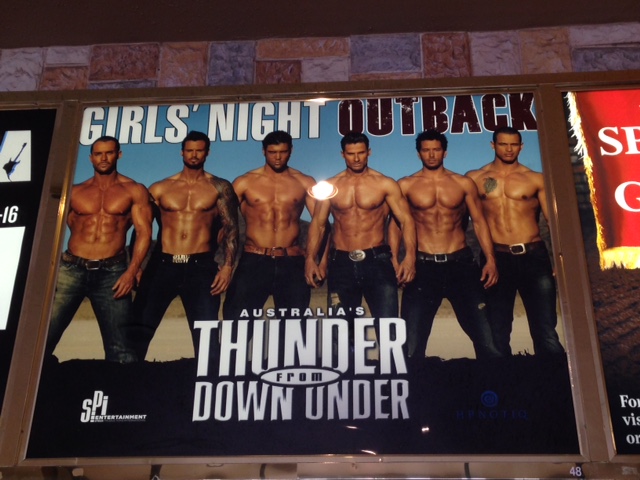
Nope. I didn’t see the Down Unders.

IMG_1815

Or Tyson. He’s sure looking good (he’s 44 now! How did that happen?).

I also didn’t gamble.

Before you think I’m utterly lame, listen to what I did do, on a girls’ weekend with three college friends:

—Got tattoos: an arm band and a dragon tramp stamp. Okay, not real: decals. But it’s the idea that counts.

—Saw David Copperfield. Yes, he’s still alive and performing two shows a day–and three times on Saturdays–at the MGM Grand. He can be dazzling–he made a vintage Cadillac appear out of nowhere! And a massive mechanical T-rex!–and so cheesy you can’t believe it. One of his acts involved a tiny blue “Martian” that needed the audience to help him get back to his home planet. A six-year-old might’ve liked this act, maybe, but Copperfield’s audience has more sixty year olds than six year olds (not to mention lots of tourists with a tenuous grasp of English; they must’ve been wishing DC would just get back to making things disappear).

—Checked out the Venetian’s fake canal, with warbling gondoliers, its fake cerulean sky overhead, and people eating in an “outside” Italian tratteria; the Luxor’s soaring pyramid and fabulous Sphinx (see selfie below); and the Bellagio, which was not so impressive. Maybe that’s because we didn’t get to see the Picasso paintings for which Bellagio is renowned. Oddly, they’re hung in a restaurant, which wasn’t open during the day (weird, surely?).

IMG_1853

What was glorious–and eventually exhausting–about Vegas were the voluminous crowds. Where is everyone? They’re in Vegas! There were moments when I thought that the broadest diversity of humanity anywhere in the world had to be right there with us on this five-mile strip. All kinds of people, young and old, from all walks of life. Even toddlers. Yes, we saw families with toddlers, strolling through the slot machines–the air stinking of cigarettes and booze–as if they were in a beautiful park somewhere. And untold numbers of young women on bachelorette weekends in stilettos and skin-tight barely crouching covering outfits. Every bride-to-be had an identifying sash or hat. One group was wearing T-shirts that said, “Look like Jackie, act like Audrey, party like Gatsby.” Only the last reference makes any sense in the context of Vegas.

I’d been meaning to try a slot machine, at least. I could not figure out how to work the damn things! There’s a slot for a credit card, I guess, but no way to know how much money you’re putting in, and then what in earth to do to play the game. But all these old people are playing away, losing their money–how hard can it be? Finally, I got my chance. At the airport, where the lame slot machines go (there was about dogs, for instance). I asked the young woman what the deal was. She showed me a dollar machine and said, “It really isn’t that hard. It’s just a question of how much money you want to spend. The more you spend, the better your odds are.” She must’ve thought I was the dumbest person on the face of the earth to ask that question.

I slipped a dollar into a dollar machine called Triple Diamond. The machine coughed and spat my dollar out. I tried again. Same thing happened. Well, then. I slipped my dollar back into my wallet.

Clearly, I wasn’t meant to gamble in Vegas. Not this time, anyway.

Revisiting Anne of Green Gables

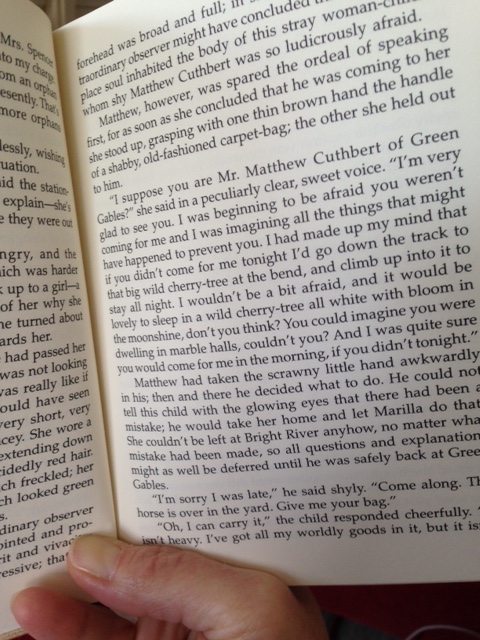
IMG_1808

I didn’t pay attention the first time I saw news about the death of Jonathan Crombie, the actor who played Gilbert Blythe in CBC’s 1985 TV adaptation of Anne of Green Gables. Yesterday, though, I found a posting on Facebook of a New Yorker article called “Why We Loved Gilbert Blythe.”

Well. I had to read that.

It turns out teenage girls all over fell in love with Crombie as Gilbert in this mini-series. “Crombie gave Gilbert caring, intelligence, and dreaminess: qualities that enchant seventh-grade girls,” Sarah Larson writes. I missed Crombie and all his dreaminess. I was in my early 20s in 1985, just out of college and living in San Francisco. I don’t think I had a television in those days. I feel sure I would’ve been tempted to watch, having been an avid reader of the whole Anne series. But I can’t feel too sorry that I missed it. Crombie sounds a bit too milktoasty for my taste. Larson prefers Crombie to the Gilbert of the books. She finds him “kinder,” with “lively” instead of “roguish” eyes, and without the mouth “twisted into a teasing smile,” as author L.M. Montgomery describes him.

Of course Gilbert is roguish! He has to be. Only a mischievous boy would call Anne “carrots” to try to get her attention, and kept trying, even after she breaks her slate over his head and refuses to accept his apology. A kinder boy wouldn’t have dared the “carrots” jibe, and there would’ve been no Anne and Gilbert, which is unthinkable.

I’ll admit Crombie looks the part. He’s got the build and coloring you’d expect, and that’s huge. And if intelligence and caring come across—well, I imagine I could fall under his spell, given the chance.

The production didn’t quite get Anne right—at least in the looks department. I looked up the photos of Megan Follows, cast as Anne, and she’s pretty and fresh-faced in a way that Anne isn’t. She was also a seventeen-year-old playing an eleven-year-old. But I can see how it would be practically impossible to find a young actor who fits Montgomery’s description: “Her face was small, white and thin, also much freckled; her mouth was large and so were her eyes, which looked green in some lights and moods and gray in others.”

I read to the point where Marilla tells Mrs. Blewett that she and Matthew haven’t entirely decided against keeping Anne, and Anne suddenly understands she might have a home, after all. A tear welled up in my eye. It’s that kind of book.

Of Chocolate Eggs and Boiled Eggs

For our family, as for many unobservant Christians we know, Easter is all about hunting for colored eggs and inhaling vast quantities of egg- or bunny-shaped candy. Eggs and bunnies are symbols of spring and fertility from ancient times, various internet sources tell me—and of course, have nothing to do with the resurrection of Christ. (In a 2012 article, The Huff Post says Easter eggs were made out of chocolate starting in the 19th century.) And neither does the serving of ham at Easter lunch, which harkens back to a time when pork was an abundant source of meat in early spring.

I love an occasion to gorge on jelly beans and chocolate eggs. I certainly do. But now that the kids are older, and we’re not having Easter-egg hunts anymore, and I’m buying jelly beans and chocolate eggs mainly for MOI—whose aging body really could do without them—I’m starting to feel envious of my Jewish friends. Passover is a holiday with rituals that are meaningful for the observant and non-observant alike. Years ago, a work friend invited me to a women’s Seder she hosted at her place. It was a revelation to have a meal imbued with such meaning. I now have to admit I don’t remember much. But wait—a memory of hard-boiled eggs is coming back. Jews don’t color the eggs and display them, they actually eat them! The eating of a hard-boiled egg (dipped in salt water and consumed at the beginning of the holiday meal) represents a traditional offering brought to the Holy Temple in ancient times, and is also a symbol of mourning over the loss of the destruction of the temple—or two temples, depending on which website you consult. (I’ve resorted to the internet because my most learned Jewish friends, my best source of information on Jewish traditions, are in Tel Aviv. If anyone reading this can correct me, please do!)

Our Easter will be a family event, a small one. I’m having my mother over for lunch. We’re having fish. I’m going to bake a few whole sea breams. I’ve never done it before, cooked a whole fish. I figure I can’t really mess up—as far as my mother is concerned, there’s no such thing as fish that’s been overcooked. We will not be celebrating the resurrection of Christ, but we will welcome spring—which really might at last have arrived—and all the possibilities of change and growth that spring promises.

What a Plunge!

IMG_1768

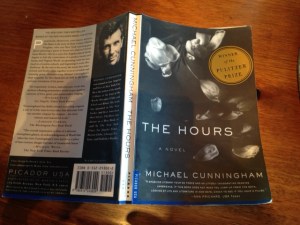
Serendipitous events: I went to a Q&A with author Michael Cunningham (at the Brooklyn Academy of Music) not long before my daughter began reading Virginia Woolf’s To the Lighthouse, not long before I found a copy of Cunningham’s Pulitzer Prize-winning novel The Hours (1998)—an homage to Virginia Woolf—at the lodge where I am now staying in Jackson, Wyoming.

So it seemed like fate: I was meant to reread The Hours.

This was a novel that everyone read and raved about, as I recall—it was The Goldfinch of 1998-99. But all I really remembered was that Virginia Woolf was a character. I’d forgotten why she was a character; I’d forgotten everything, in fact. Until I started reading, and I began to remember. One of the main characters is Cunningham’s version of Clarissa Dalloway, who, in the first chapter, is going off to buy flowers for a party. Later Woolf herself sits down to write the famous first line: “Mrs. Dalloway said she’d get the flowers herself.”

It’s one of few first lines I have never forgotten in all the years since reading Mrs. Dalloway in high school. It’s so simple, and at the same time so distinctive and yes, unforgettable.

In a very funny article Cunningham wrote in the New York Times in 2003 after The Hours was turned into a movie (remember Nicole Kidman with the fake honker, playing Woolf? And then winning the Oscar?), he describes talks about Mrs. Dalloway this way: “Woolf’s novel takes place in one day, during which Clarissa Dalloway, a 52-year-old London society hostess, shops, sees the man she might have married but did not, takes a nap, and gives a rather dull party. However, because it is an ordinary day in the life of an ordinary person as rendered by a genius, by the book’s end we understand that Mrs. Dalloway not only stands with the heroes of world literature but, by extension, that every one of us might stand so, if only a brilliant writer would look at us with sufficient depth and penetration.”

Cunningham makes me think I should be going back to his source of inspiration, but I’m happy to have The Hours in front of me. When his Clarissa centers herself in the moment, in her life, it seems like just right thing to be reading, as the spring we’re all longing for teeters on the edge of being.

“Outside the narrow kitchen window the city sails and rumbles. Lovers argue; cashiers ring up; young men and women shop for new clothes as the woman standing under the Washington Square Arch sings iiiii and you snip the end off a rose and put it in a vase full of hot water. You try to hold the moment, just here, in the kitchen with the flowers. You try to inhabit it, to love it, because it is yours….”

And the Book for the Ages is…

My 16-year-old daughter sorted through her old picture books last night, the dozen or so that are still in her room and not in cardboard box in the attic. I wish I could say she was in need of the distilled wisdom, or the simple joy, that a picture book can offer. No, she was on assignment. Vanessa is a junior, which means nearly ever waking moment is dedicated to schoolwork. She was looking for a childhood favorite to talk about in Spanish class. She considered A.A. Milne (the unforgettable When We Were Very Young and Now We Are Six) and the Narnia books. Then she found it. The one book to rule them all—hidden and lost, until now.

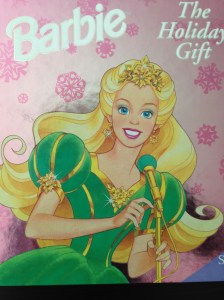
Barbie: The Holiday Gift.

It begins like this.

One sparking winter day, Barbie hurried to the home of Mrs. Jenson, the town seamstress, to try on her gown for the Holiday Snowflake Parade. Barbie had been voted the parade queen, and her friends were the princesses. They were going to ride together on a float in the parade. “Your dress is almost finished,” Mrs. Jenson said, as she led Barbie into her sunny sewing room. “Oh, it’s lovely,” Barbie exclaimed when she saw the dress of rich, green satin. “I can’t wait to try it on.”

Barbie’s a queen of a girl, in more ways than one. Mrs. Jenson’s young niece, Laura, is shy, but she happens to have a beautiful singing voice. Barbie comes up with an idea: Laura could join her and her friends on the float and sing a song. In no time, she wins the mayor’s approval to go ahead with the singing (yes, the mayor has to get involved!), and the teens pool their money to buy fabric for a dress for Laura—pink velvet, no less. The ever talented Barbie designs the dress, which Mrs. Jensen makes in secret. On the day of the parade, Barbie surprises Laura with the dress and her idea. Laura is suitably thrilled, and ends up wowing the crowd with her voice. Laura can’t thank Barbie enough. She tells her:

“You not only gave me new friends, you helped me overcome my shyness. Those are the best gifts I’ve ever received.”

But Barbie has the last word.

“You gave those gifts to yourself, Laura, by sharing your voice,” Barbie replied. “And what’s more, you also gave all of us a very special holiday memory.”

Oh, so many special gifts!

I read this book over and over to a rapt Vanessa. So did her beloved babysitter, Carla, who gets the credit (no blame!) for buying the book.

The stilted language, the lackluster story line—Vanessa never noticed. She couldn’t get enough of those dresses. Oh, the dresses. Aside from Barbie’s blindingly green dress, there was Laura’s. That might’ve been Vanessa’s favorite. It had ruffled tulle-ish sleeves, gold ribbons and—gasp—a rose at the waist. Barbie’s four princesses also wore gowns on the float, each a different hue—pink, yellow, blue, and oops, another pink, a deep, dusty color that I can’t seem to find a better way to describe. Which was the prettiest? We pondered this endlessly. (Unbeknownst to her, I thought they ranged from hideous to only slightly less dreadful.)

“I think this book made me think about fashion for the first time,” Vanessa said, with only a hint of sheepishness.

Barbie, a fashion inspiration? I guess that’s not so hard to believe, when the person being inspired is all of four years old. Vanessa did not fall in love with Barbies, though. Not like I did. I spent years happily playing with Barbie and like dolls. Many experts argue that Barbie’s outrageous proportions give girls the wrong idea about what’s a healthy body size. That could well be. I don’t remember thinking about Barbie’s body—except to be amused that she had leg hinges where her butt should be. I didn’t care to see her naked; the whole point of having a Barbie was to dress her. My grandmother used to make clothes for my Barbie. (She wasn’t Barbie herself, actually; she was a brown-haired chick with bangs, quite pretty ’til I dabbed lipstick on her and the lipstick rubbed off, staining her face.) Putting clothes on, taking them off, putting something else on—it was all so deeply satisfying and enjoyable.

What I suppose I’m saying is: I had a positive Barbie experience, and my daughter did, too. As to The Holiday Gift: Now that Vanessa’s rediscovered it, I’m clearly going to have to save it for her. Who knows—it could end up being something she passes down to her daughter, this little board book, published by Fun Works in 1997. It’s still out there, in a small way. I found it selling for a buck, used, on amazon. There’s a whole new line of Barbie books, I see. Now she’s a modern-day princess with…super powers! And also a vet, a pediatrician, a teacher and a ballet dancer. I’d like to see Barbie the engineer, or Barbie the astrophysicist, or Barbie the head of Goldman Sachs. Perhaps I’ll find our Barbie book again when I’m, say, helping Vanessa pack her things to move to her first house. That’s got to be a good eight, ten years from now. We’ll see what Barbie’s up to then.

Mark Twain and the Bohemians

Recently I was lucky enough to meet Ben Tarnoff, the author of The Bohemians: Mark Twain and the San Francisco Writers who Reinvented American Literature (2014, Penguin Press). Ben happens to be my neighbor’s son-in-law, and he graciously agreed to meet with our book group. Bohemians is an engaging, colorful account of a period of American literary history that I for one knew nothing about. Ben focuses on the four best known San Francisco-based writers of the post-Civil-War period—Twain, Bret Harte, and the poets Charles Warren Stoddard and Ina Coolbrith (the first poet laureate of California). Twain and Harte wrote bold, irreverent California-based stories, fiction that was new and wholly American.

Now–I haven’t finished the book, and while I can highly recommend it based on the two-thirds of it I’ve read, I’m bringing up Ben because of what he said about the writer’s life–his own. I asked him if any part of the book had been especially difficult to write, and he said, “All of it.” He said he’d finish every day of work convinced the pages he’d just written were absolutely terrible. If he felt jazzed about what he’d written, he was sure to find it abysmal the next day.

A successful young writer (he’s also the author of A Counterfeiter’s Paradise, a history of the early years of the American financial system) doubting his abilities at every turn. What else is new, you say? True enough, but it’s always comforting to hear a published writer confess his or her insecurities. I almost felt a stab of pity: I feel good about my writing some days; I don’t think it’s awful every day! I almost got there, to the stab, but I only got as far as near pity. The fact is, whatever his method is, it’s working. His book is beautifully written (at least the part I’ve read is). And I look forward to his next work, whatever that may be—and good Lord, we didn’t even get around to asking him what he was working on.

The Iceman Cometh

I can’t last through a two-hour action flick without falling asleep at least once, but guess what—last night I was alert and engaged for the entirety of a FOUR-HOUR-LONG  play. Here I thought the problem was old age, but no! The relief of it—I just needed BETTER writing and acting! In this case, I’m got superior writing and acting in the form of Eugene O’Neill’s The Iceman Cometh, now playing at the Brooklyn Academy of Music.

it’s not an easy play to watch. A dozen or so drunks spend their days and nights at a bar in the Bowery (the year is 1912), using booze to disguise the hopelessness of their lives. Then their friend Hickey shows up and tries to help them get rid of their illusions—which only leads to more bitterness and despair. An incredible cast, led by Nathan Lane and Brian Dennehy. It’s not a flawless play—Hickey repeats himself so much it was distracting—but that seems like a quibble in light of its achievements. Another example of how powerful and enduring the best writing is.

Is it self-defeating to say I can’t hope to be as great a writer as O’Neill? I figure I’m not being self-defeating so much as realistic. The man won four Pulitzers and a Nobel, for crying out loud!  I have to point out that what I’m writing isn’t even eligible for such honors; I dream about a Caldecott.

Which reminds me: It’s time to get back to writing. Re-fueled, unexpectedly, by a spectacle of sheer hopelessness.

A Beef to Warm the Bones

How could I have forgotten about Liz Ann’s brisket recipe? It’s tender and smoky (you’ll see why in a minute) and utterly delicious, without or without a hearty roll or hamburger bun and BBQ sauce, but I recommend both. Good thing Super Bowl XLIX, or I should say the need to make food for my Super Bowl XLIX guests, led me to rediscover this tasty crowd pleaser.

Punxsutawney Phil is predicting six more weeks of winter. What else is new? We East Coasters (north of Washington, D.C., anyway) know that February is always cold and crummy, and let’s face it, much of March is, too. In other words, the time for brisket is now!

Liz Ann’s Brisket

1 brisket of beef, approximately 5 pounds
1 TB natural liquid smoke
2 tsp. salt
1 tsp. paprika
1 tsp. garlic powder
1 tsp. dry mustard
1 cup beef stock
Preheat oven to 325 degrees.

Combine spices in a small bowl and mix well. Brush brisket with the liquid smoke, then rub spices into brisket. Place meat in a covered Dutch oven and bake until fork-tender, about 3 1/2 hours. Begin checking after 2 1/2 hours; if natural juices have dried up, add the cup of beef stock.

Remove from oven. Cool slightly then cut meat into 2-inch strips. Using two forks, pull meat apart, Return meat to pan juices (you can add more beef stock if needed).

Serve on sandwich rolls with BBQ sauce. Great with cold beer. Makes 8-10 sandwiches.

Post Navigation