alexandra alger

ABC

A Play on the Mirror Cliché

I read this in a recently published crime novel: “As he reached for his Visa, the security monitor next to the register caught Billy in all his glory: football burly but slump shouldered, his pale face with his exhaustion-starred eyes topped with only half a pitchfork’s worth of prematurely graying hair.” As you might’ve guessed, Billy’s a cop—more specifically an NYPD detective on the graveyard shift (his last name is actually Graves).

Here’s my theory. The author (prolific, successful) wanted to give us this image of Billy but wasn’t going to stoop to using the old he-looked-in-the-mirror technique. Besides, Billy doesn’t look in mirrors. That much is clear. So…a security screen! At the Korean deli where he buys the crap that’s supposed to keep him awake all night!

Pale face, exhausted eyes, gray, thinning hair (is that what “half a pitchfork’s worth” means?)— that deli has one high-resolution monitor! Maybe security systems have gotten more high tech lately. I try not to look at the screens myself—a) because I don’t want the person behind the register to think I’m vain enough to want to check myself out; and b) when I can’t resist glancing up—just a glance!—the picture is so grainy and dark I don’t automatically recognize myself. Does anyone look reasonably like themselves in security footage? If I could, I’d make this point to the author (whom I will identify shortly). I’d also have to add, isn’t it kinda cheesy? Is it any better than the mirror cliche? He could argue that Billy, whose coloring is gray and white and black, shows up perfectly. He could swear that in the delis he knows with security monitors, people look themselves, and anyway, security footage is as key to Billy’s life as iPhone pictures are to the rest of us. My only rebuttal would be that I could envision Billy perfectly without the security image.

The Whites, by Richard Price, writing under the pen name Harry Brandt; Henry Holt, 2015. It’s worth reading, if you like stories that go deep into the lives of NYPD detectives dealing with the ugliest crimes imaginable. A memorable array of cops and low-lifes and people struggling with circumstances they didn’t deserve.
A Waggish Aside

Waggish—I’ve seen this word twice recently, in two different articles, both in the context of political commentary. Politicians tend to invite mischievous humor, for obvious reasons (believe it or not, neither story was about Trump—or Palin or Cruz!).

Waggish! Meaning silly; humorous, in a mischievous, or facetious way. Why don’t I ever use this playful word?

Come to think of it, I don’t hear it much in conversation. I never heard it in conversation. Is “waggish” a part of anyone’s day-to-day vocabulary?  Is there somewhere someone cooing to her child, “Oh, you little wag!” Or flirtatiously: “What a waggish thing to say!” Or admonishingly: “No waggish comments when Mother gets here.”

According to the Online Etymology Dictionary, the word “wag,” dating from the mid-sixteenth century, was a “person fond of making jokes.” The origin of the word is murky—it could be a shortening of a early-German word used to describe pranking children. My vote goes with what seems obvious—it’s based on the transitive verb, which was used to describe what dogs did with their tails as early as the mid-1400s. What’s more joyful (and possibly a sign of mischief-making) than a dog (I picture a Lab or Golden Retriever) wagging its tail?

That gives me an idea for a story….

Cobble Hill, in Snow

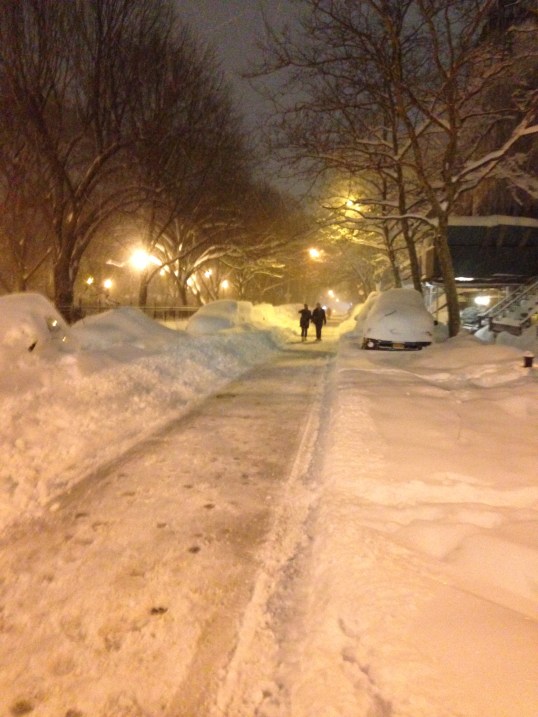
IMG_2512I took this Saturday night, around 8:30 pm, on the corner of Clinton and Congress streets. The sidewalks were barely passable, so everyone out was walking in the streets. It was a funny thrill, walking smack in the middle of Clinton, without a car in sight, and without any of the usual street noise, except for the roar of snow plows. The magic was over by the morning; the snow plows had done their work. The cars had taken their roads back.
Anyone know a good character plumber?

The Canadian writer Sheila Heti wrote recently in New York magazine about an ah-ha moment she had about writing many years ago. She was in her early 20s, writing a short story that would become the wonderfully titled The Princess and the Plumber. At one point a frog is giving love advice to the plumber. She remembered feeling “an inner obligation” to continue the conversation between the two, even though she didn’t know what else they had to say to each another. “Then I suddenly realized that there was nobody looking over my shoulder, and that nobody had any greater authority over what should happen next than I did.” The conversation ended; the plumber turned and walked away.

Don’t you love the idea of a frog giving love advice to a plumber? I can’t wait to find this short story! (It’s in a collection of Heti’s called The Middle Stories, published in 2002 and reprinted, with additional stories, in 2012.)

I know many writers who feel their characters take charge and all they as authors can do is follow along. “I didn’t know what was going to happen next,” one friend told me not long ago. “And then the doorbell rang!”
I like to think I have ultimate authority over my characters. If only they weren’t such an independent bunch—sometimes terse and inscrutable. I have to coax thoughts and feelings out of them, burrow into their furtive minds. Every writer has to be a plumber of sorts, an un-clogger of minds and hearts.

Instead of Hay, Make Gravlax

Here we are, in the second week of January, and even as I have now cleared out the tree, put away the decorations, chunked the left-over chocolate roll and candy-canes, I’m still stuck in holiday mode. All I can think about are recipes and online shopping. I’ve now scanned resort wear on the Bergdorf Goodman site at least twice. This is a disturbing trend for someone who doesn’t ordinarily like to shop. I’ve also bought things that are easy to put off, because they’re boring and no one really cares about them.Wash clothes, for instance. I found time to buy two white wash clothes (on sale!). And a pillow, for my side of the bed, because my current one’s been deflating for a while.

I know what I’m really doing. You do, too, I’m sure. Procrastinating. Putting off getting back to finishing the first draft of my new MG book. (Only first draft, and I’m deep into second- and third-draft-quality procrastination.)

By now I’m getting so annoyed with myself that I know I will (soon, very) get back to work. After I make gravlax.

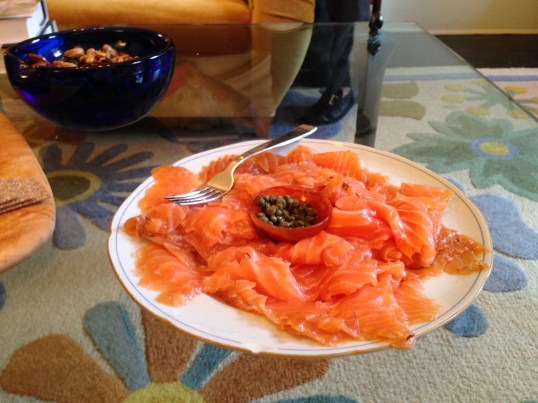
Homemade gravlax. The preparing of it is a sort of antidote to procrastination; your energy goes into looking forward, into anticipation, because gravlax needs three days to cure in the fridge. I made it for Christmas lunch; couldn’t believe how easy and utterly delicious it was.

IMG_2451

I made this batch from a recipe in the December issue of Food and Wine: Pink Peppercorn and Fennel Gravlax (I’d type it out here if it weren’t readily available on foodandwine.com).

Whoa, Nelly—my eyes did a double take. Pink Peppercorns? Well, doesn’t that sound pretty, I thought. I know, I’m showing my less-than-foodie-level knowledge of spices. I also needed fennel pollen. In the pre-internet days, I would’ve had to search far and wide for such exotic items, but no longer. Within two days, thanks to amazon, I had them.

The basics: You buy a nice piece of salmon fillet, envelope it in spices, salt, sugar and sprigs of dill, wrap the whole thing in plastic wrap, and let it cure in the fridge, weighted down, for three days. There a few other steps, tiny ones; and that’s it. Those Scandinavians are brilliant! And you will be, too. Find the recipe, if you can get all the ingredients together by Wednesday, you can be gorging on gravlax this weekend. Let me know if you are anything but delighted by the results.

Oil & Vinegar, Anyone?

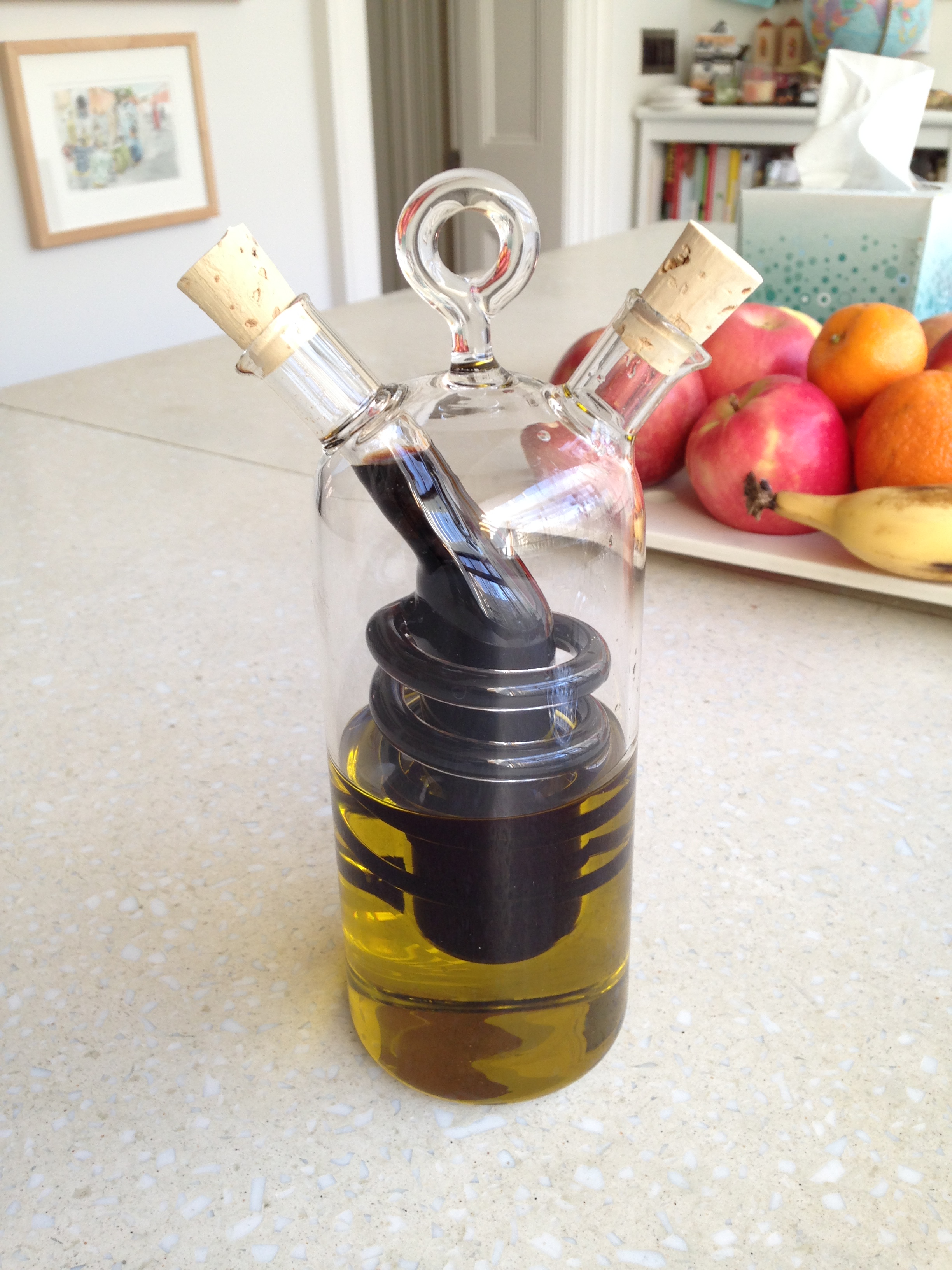
IMG_2487.JPGMy twenty-year-old son Davison gave this clever oil-and-vinegar vessel to me for Christmas.

I told him about two books he could get me; I wanted to make things easy for him, and I really do always love a book. But he went off and found me something that I didn’t even know I wanted! I’ll be eating more salad now, for sure, which I’ve been meaning to do for quite a while. It’s one of those vague New Year’s resolutions that barely survives the first week of January. But guess what, I’ve had two salads already this week, and it’s only Wednesday! Thank you, dear Davison, for thinking about my pleasure and my health!

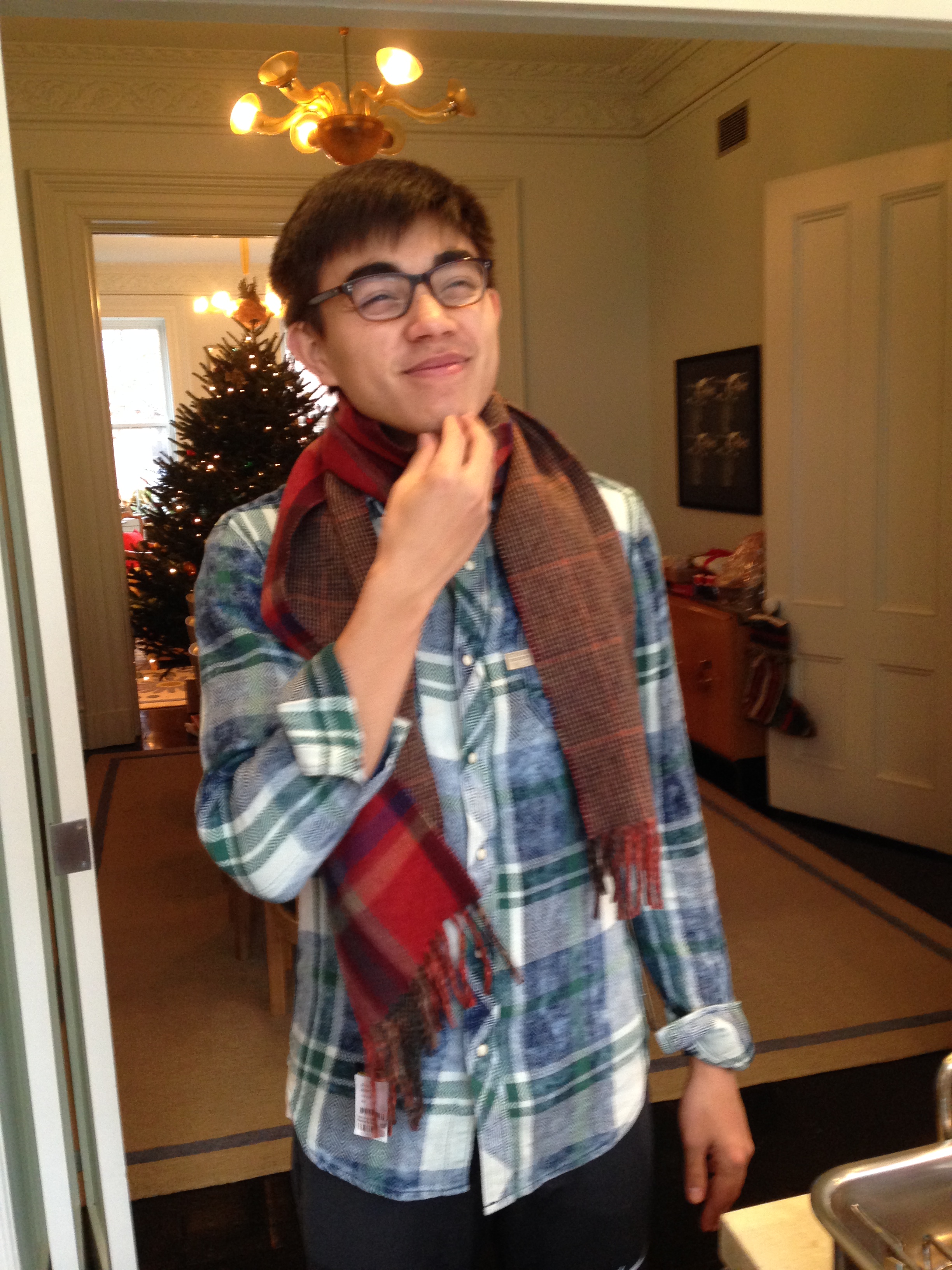
Here he is, wearing my reading glasses and a new scarf. He’s affecting the Brooklyn writer look. (He writes well but is not, in fact, interested in writing. He likes problem sets. Multi-variable calculus. Statistical analysis. There’s more but I don’t know how to describe it. Literally, I don’t understand it enough to describe it.)

IMG_2448.JPG

It’s interesting how some people are naturally good at finding gifts that please those who receive them. I say “naturally,” because I do think it’s a trait that one is born with. I remember when Davison was in sixth grade and had to find a Secret-Santa present for girl in his class, but nothing that cost more than ten bucks. I went with him to a local shop, and he picked out a set of dangly earrings on sale for exactly ten dollars. They were cute! I thought he’d nailed this Secret Santa thing; this girl was going to be totally wowed. It didn’t sound like she was, in the end—I don’t know why, I only heard part of the story—but the point is, he showed early promise in the gift-giving department.

( All right, yes, I’m still a bit irked at the girl for not being wild about the earrings, even after all these years. The Secret Santa tradition, it seems to me, promotes more ill will more good will. Parents get drawn into finding a present for a kid who may well not like it; their own child may be just as disappointed; and the whole notion of giving as a gesture of the holiday spirit goes by the wayside. I thought maybe Secret Santa had been junked, but I just came across a posting by someone who goes by Crappy Christmas Letter on Be Like Water Production’s blog, whose daughter just had a bad S.S. experience. Crappy Christmas (interesting name there) wrote about having a fun time picking out a pretty box and necklace and chocolates with her fifth-grade daughter, Elizabeth. Surprise, surprise: The recipient didn’t like her offering and had no trouble telling Elizabeth as much. By the end of the post Crappy Xmas was plotting some kind of public humiliation for the girl.)

Back to Davison. He’s going to be put to the test in the next few months: He’s confronting, in quick succession, his girlfriend Sidney’s birthday, Valentine’s Day and the one-year anniversary of being with Sidney. What a terrible trifecta! I never had to face that kind of pressure. Good thing, because I’m not sure I could’ve handled it. I would’ve ended up buying, I don’t know… what might have I gotten one of those guys I dated in college? I’m straining to think of an idea, but I’m blank; completely blank. Ah, well, that was a long time ago. But Davison’s go this thing in hand, he has assured me. Of course he does. He’s a natural. He’s just going to get better and better at giving presents. I can’t wait to see what he gets me next Christmas.

Here’s to 2016

I love the holiday season. How festive the city is, ablaze with Christmas lights, both ethereal and gaudy, Balsams greening up street corners, shops bright and busy. I thrive on the chaos the season brings. It’s a delicious kind of stress, the only good kind I can think of it—the mad scramble to find gifts and get the holiday cards out and plan the Christmas lunch. Every year I wonder how it all gets done, and it always does. This year, for the first time in memory, I got all the presents wrapped before Christmas Eve. It was fantastic to not be up at midnight, blearily trying to masquerade the ends of a Lego set with what’s left of the wrapping paper. And the years of trying not to slip up and wrap Santa’s gifts in the same paper as Mom and Dad’s! (Nothing got by those kids— they were quick to point out if Santa had the same wrapping paper, challenging me to admit something I never would and never will. You’ll never heard me say I don’t believe in Santa!) This probably sounds either pathetic or crazy to those of you who get your holiday shopping done byThanksgiving. I have met a few of your number, so I know you actually exist. I can never hope to be in your company, O otherworldly ones!

And now it’s coming to end, once again, and 2015 is nearly over. Oddly, I feel as if 2016 is already here. I’m lacking my usual, roll-up-the-sleeves, I’m-gonna-do-it-all sense of resolve when facing a new year. Is it age? Am I just at the point at which time, as meted out in human-ordered increments, has no meaning? Is it just that the number six doesn’t look so different from the number five?

Partly to blame, now that I’m thinking about it, is the state of the world. It’s hard to look ahead with optimism when there is so much to worry about. When and where terrorists will strike. The plight of Syrian and other refugees, short and long term (Germany alone has taken in nearly a million so far and pledges an open door—but can it house and find jobs for so many? Can and will they all assimilate?) At home the appalling slate of Republican candidates. If any one were elected, we wouldn’t be living in a country I recognize (Kasich would be okay, but he doesn’t seem to gaining any traction). Hillary better win. She’s going to, she’s got to. She must.

The world’s problems are taking some of the fizz out of my champagne, but not all. I’ve got resolutions, I’ve got ‘em. Some of the usual suspects are on the list, of course (i.e. reduce ice-cream, red wine consumption; get an agent, get published, etc.) Here’s a new one: I want this latest novel I’m working to be really good—objectively, no-doubt-about-it good. I tend to like my own writing, but I know when things aren’t entirely right—the plot’s going limp, a subplot isn’t jelling, voice is off. So self: Let’s pull it all together this year! And here’s to excellence in your work, fellow writers!

When the Real World Intrudes

I didn’t get a lot of writing done this week, glued as I was to reading about protests and discussion about racial discrimination at Yale, my alma mater. I learned that many students of color are subject to racial slurs and comments that other students—and faculty members!—don’t even seem to realize they’re making. I learned that black women in particular feel that Yale isn’t theirs and doesn’t care about them. I couldn’t believe what I was reading at first; the Yale I knew was a place of equality and respect for everyone, regardless of background, gender and race. Wasn’t it? A stream of Facebook comments, blog postings and articles by African-American alums and current students let me know how clueless I was. Powerful, frank and true words from Roxane Gay in the New York Times today:

“There is a degree of safety members of certain populations will never know. White people will never know the dangers of being black in America, systemic, unequal opportunity, racial profiling, the constant threat of police violence. Men will never know the dangers of being a woman in America, harassment, sexual violence, legislated bodies. Heterosexuals will never know what it means to experience homophobia. Those who take safety for granted disparage safety because it is, like so many other rights, one that has always been inalienable to them. They wrongly assume we all enjoy such luxury and are blindly seeking something even more extravagant. They assume that we should simply accept hate without wanting something better. They cannot see that what we seek is sanctuary. We want to breathe.”

Even as I was reading these words,  the terrorist slaughter in Paris (a lack of safety on another order entirely) was distracting me. My husband Dan and I have passed much of the last two days watching updates on T.V. (Count of the dead up to 132.; attackers being traced to an impoverished Brussels suburb.) It seems to me the French authorities have worked exceptionally fast. They have already pinpointed members of the terrorist group who are still at large, including a French citizen whose photo has already appeared so frequently I think I would actually recognize him if I saw him. (To be the one to bring him in—what a thought; the stuff of fiction!)

In Paris, schools, museums, the Eiffel Tower, all will reopen tomorrow. The French will leave their homes and try to go about their lives once again. We New Yorkers who lived through 9-11 understand their fear. We lived it. We survived, and they will, too. And working together the world’s major powers will dismantle ISIS. I have to believe they will.

Ghoulish Fun

IMG_2278Not bad, eh? “Traditional,” my daughter commented. I didn’t pay her any mind. It’s the best carved pumpkin we’ve probably ever had! My husband Dan deserves the credit for the carving (based on a drawing we found online under “pumpkin faces.” Thank you, internet!). Somehow I was able to cajole him into doing it, while I stood by and watched. Is this ever the way to go–carving that baby the weekend before! So much more enjoyable than the the routine established after the kids lost interest in the pumpkin (and Halloween decorating in general): I’d put off the carving until Halloween day, until about, oh–an hour before the trick-or-treaters were due to arrive. The pumpkin, after a few weeks’ on the stoop, would be old and tough and resistant to the tiny saw from the pumpkin carving kit.  I’d default to the most basic pumpkin happy face, the one with triangle eyes and the gaping grin. Then I’d rush, rush, rush to throw a witch’s wig on, spread black makeup on my face (if I have time, black wax on my teeth–it really freaks kids out) and dump the candy into the big ceramic bowl that only comes out on Halloween. I sound like a pathetic whiner and procrastinator, don’t I? No more whining, from this day forward. Because now my talent husband’s in charge of the pumpkin. “Honey, you did such a good job last year, you have to do it again,” I’ll say this time next year. And he’ll have to agree.

Food in Kids’ Books

The MC in my new manuscript likes food. It’s not her defining characteristic or anything, but she lives in Brooklyn, New York’s foodie-est borough. You have to try really hard (or be a two-year-old) to avoid good food in Brooklyn.

Middle-grade characters known for a food they like or dislike: It’s a rare breed. There’s only one character who pops into my head immediately: the grumpy, quirky heroine of Harriet the Spy, who ate a tomato sandwich (white bread, mayo) for lunch every day. When I read Harriet back in the day, I was as revolted as author Louise Fitzhugh probably wanted me to be. Tomatoes were like lettuce to me: watery, tasteless. What was the point in eating them? There were no organic Heirloom tomatoes trucked in from upstate farms in the 1960s, when Harriet the Spy was first published, or in the ‘70s, when I was growing up.

Then there’s the poor giant in Roald Dahl’s The BFG, who subsists on snozzcumbers, probably the foulest vegetable (real or not) in children’s literature. Sophie the orphan can’t even swallow one bite. “‘It tastes of frogskins,’ she gasped. ‘And rotten fish!’ ‘Worse than that!’ cried the BFG…’To me it is tasting of clockroaches and slimewanglers!’” (I looked that up, in case you were thinking I had amazing recall.)

There may be others. Overall, though, I’d say that food has not been a big motif in kids’ books for the simple reason that it hasn’t been a big focus for kids. It can be a source of enjoyment (Yay, pizza!) or conflict (Mom insists you eat breakfast, but you’re late for the bus; a mean kid at school makes fun of your lunch). But traditionally—both in life and fiction—eating is something done in between activities; it’s not an activity in itself.

That’s changing a bit. Kids are way more sophisticated about food than they were even ten years ago. More and more, they have tastes that span the globe. They eat fish tacos and Bánh Mì pork sandwiches and sushi and Pad Thai. Last week, the Wall Street Journal published a story on the American child’s expansive palate. According to the Journal story, households with children under 18 are twice as likely as households without children to have eaten Korean, Indian, Thai, Hispanic or Caribbean in the last three months.

Have children actually become more adventurous eaters than their parents? That would be quite an extraordinary thing. If the Journal is onto a real trend, I’m guessing we’ll see increasing numbers of fictional characters with foodie sensibilities.

We’re already being introduced to a few characters who know their way around a kitchen. Gladys Gatsby, the protagonist of Tara Dairman’s Four Stars (2014), is a budding chef; Moses LoBeau, of Sheila Turnage’s Three Times Lucky (2012), steps in when needed to run the breakfast service at Miss Lana’s café (she comes up with a menu she can handle—“a full line of peanut butter entrées”). A kid chef with a TV show—that’s coming next. I’ll be looking for it.

Post Navigation