alexandra alger

ABC

Highlights

I participated in a four-day picture-book boot camp at the Highlights Foundation last weekend. Days later, I’m still sifting through my thoughts about the whole experience, what I learned, and what I had to relearn.

There were twenty of us, all author-illustrators save for four –five?–who were writers only. The whole weekend, I thought of myself as “just” a writer, a lesser person, frankly, than these extraordinary individuals who could tell a story both in words and pictures. Honestly, I’d never recognized how much work goes into the pictures alone.
 

IMG_3169.JPG

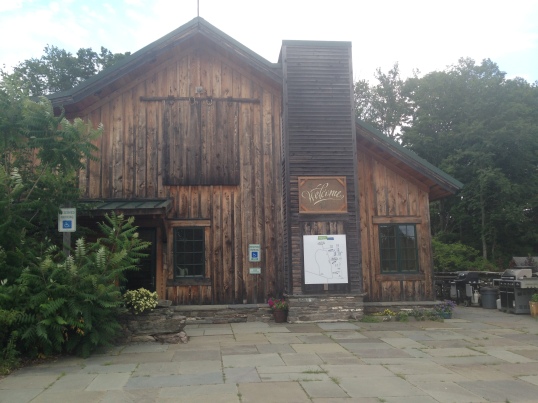
The Highlights campus lies in bucolic northeastern Pennsylvania, ten miles from the town of Honesdale,  home of the Highlights magazines for kids. Here’s the barn, where we met for meals and had many of our critique sessions. It really reminded me of the lodge of my summer camp, Green Cove, down in North Carolina. The food was much better, though. The food was astoundingly good. Everything was from a farmer’s market. Eggs  and sweet New Jersey blueberries at breakfast; homemade soups and salad and hearty breads at lunch; for some reason I’m blanking on the dinners, but they were delicious, too. And with all that,  because we are children’s writers, after all, we could have ice cream anytime we wanted. That’s right. Highlights has an ice-cream bar. With sprinkles. Two kinds. You’re searching for the Highlights schedule right now, aren’t you?
IMG_3173

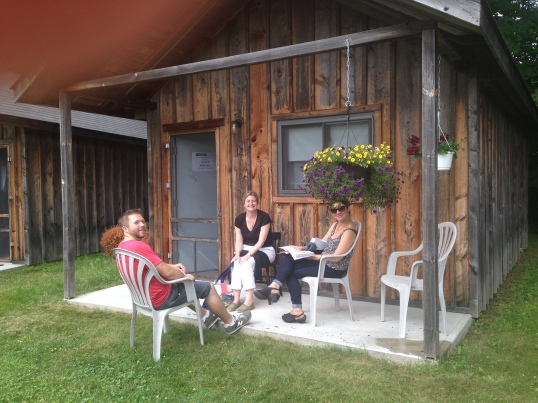
Most of us stayed in individual cabins like this. Simple inside, with two single beds, a dresser, a small desk, a mini fridge (with seltzer and sodas inside–a thoughtful touch). Here are three of our talented group–from left to right Merrill Rainey, Kristen Bannister and Sabina Hahn. I feel sure you’ll be seeing their names in print at some point soon. It’s a funny thing, how quickly  strangers can bond when they have a common goal. We were all there to polish a particular work, and we were all eager to share it with our own kind. We were members of a tribe coming together for the first time.
IMG_3185

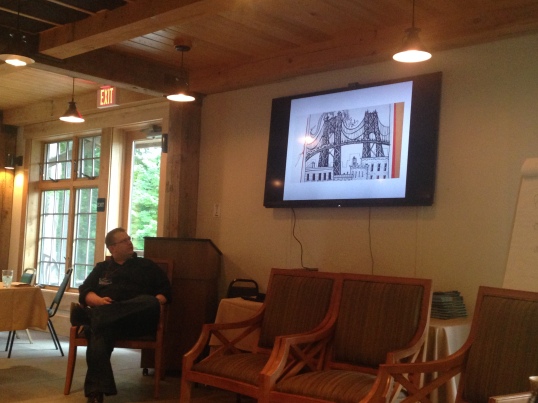
I worship the faculty–four noted author-illustrators,  Pat Cummings, Denise Fleming, Steve Light and Floyd Cooper. Here’s Steve in the Barn, talking about his career. My photo’s crummy, but note the fantastic ink illustration on the screen. Each one of them gave me something valuable to think about.

The crux of the weekend was a 15-minute meeting, for each of us, with a publishing trio: an editor, an agent and an art director. Of course, we were all incredibly nervous. And hopeful; a few of us had agents or books already out, but most (like me) were looking for their big break. I was pitching a biography that I thought was compelling, naturally.

It wasn’t for them. So be it. I did get some feedback I can run with,  having to do with digging more deeply into my character. That rang true to me, and that’s what I’m working on now.

Other boot-camp takeaways:

  1. Make a dummy for every revision. I mean writers–it’s obvious that author-illustrators need to make them. A dummy magically reveals where the story falters or where it needs more room–it’s astonishing. I knew this, and yet had managed to arrive at boot camp without a dummy for my manuscript. Denise Fleming, bless her, had a pile of ready-mades ones that she’d brought for us. ( I think she said she’d stitched them on a sewing machine. She’s amazing.) Once I’d put mine together, I saw all kinds of possibilities I hadn’t before.
  2. Make your writing irresistible to read out loud. Punch up the text. Shorten sentences, use lively verbs.  Cut out any “then”s. (This last was Floyd’s pet peeve, and for good reason. A “then” is usually a sign of flabby writing.)
  3. Stay true to your idea, and to your writing, but keep an eye on the realities of the marketplace. Some ideas aren’t going to lead to a book deal. Which leads to….
  4. It’s not you it’s me: Editors’s decisions are subjective. They like what they like, and sometimes they don’t want things for reasons that are entirely personal. As Pat put it, in her inimitable way, if you’re pitching a cat book to an editor who was mauled by a cat as a child, that editor isn’t going to want your book, no matter how good it is. Knowing this doesn’t prevent the sucker punch of rejection, but it’s something.

I know my group of boot campers is hard at work right now, using the ideas and inspiration from the weekend. A few are already starting to submit. One may well have a contract (I’m waiting for confirmation).  I salute this talented bunch!  In one or two year’s time, boot campers’ will have books on sale. Fingers crossed.


A Brooklyn Walk

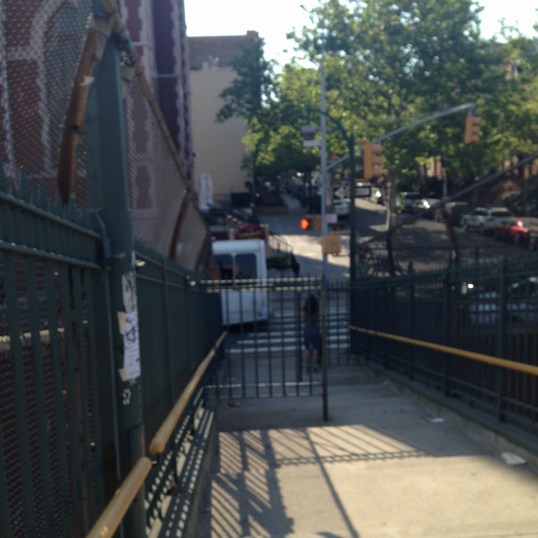
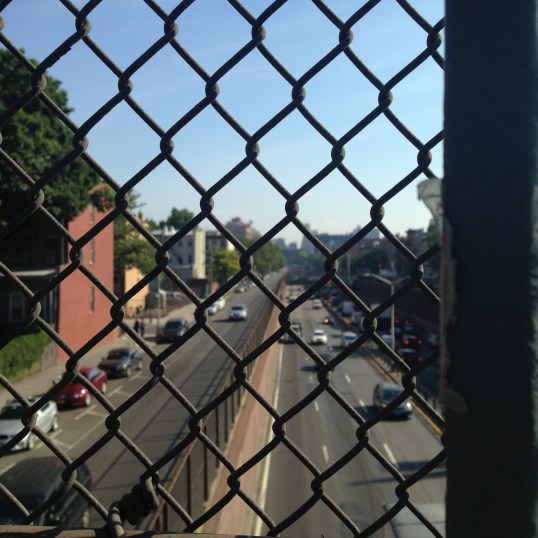
I was walking home from the southern end of Hicks Street, where I’d taken my car for an inspection, when a bridge appeared in front of me–a metal pedestrian bridge that stretched over the busy four lanes of two-way traffic. In two decades of driving up and down Hicks, I’d never registered the existence of this bridge. Which is really strange, but there it was. Of course, I had to walk across it. Here’s the view north:

IMG_3143.JPG

And to the east:


IMG_3144

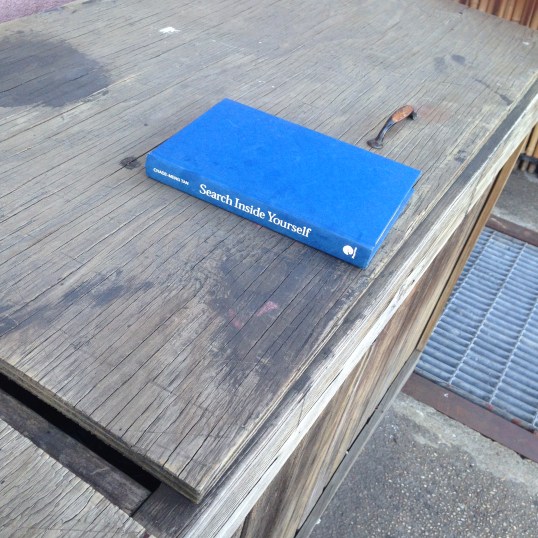
There’s nothing like a bridge for a new perspective. Walking on the other side of Hicks now, I passed a slim hardback book sitting on top of a garbage bin.


IMG_3146

Will do, I thought. I picked up the book. I was fated to take it, wasn’t I? When I saw it was written by a Google engineer, I decided against it. I wasn’t going to assign Google the power of the universe. Enough already. But I admired the contrast of the vibrant blue against the battered wood. It’s a Brooklyn tradition, to leave books outside for others to take. Granted, most of the books are old, quirky or obscure titles that no one else wants either, but the impulse is nice, I’ve always thought.


IMG_3148

Taking Sackett Street east, I passed this evocative painting hanging in a window and realized I knew the painter: Ken Rush, who taught art for many years at my children’s primary and middle school, Packer. What an oddly satisfying 10-minute walk, which began with something new and ended with a memory from the past.

L.A. Story

In Los Angeles for two days, there was time for only the highlights of the sprawling city–food, art and beach. Heavenly fare at Gjelina, not too far from the Getty Center (and we glimpsed Christoph Walz, of Quentin Tarantino’s must-see films, Inglourious Basterds and Django Unchained, having lunch with his wife and a son ). Also tasty: Norah, in West Hollywood (I feel kind of cool being able to throw around “West Hollywood,” as if I know what I’m talking about) and Otium, next to The Broad museum. You’re now starting to get a sense of our schedule: Museum in the morning, then satisfying lunch with some kind of alcoholic elixir. Brilliant combo, which leaves the rest of the day pleasantly open to aimless wandering. The distance between areas of interest are usually enough to discourage concentrated site seeing.

A few things I love about L.A.:

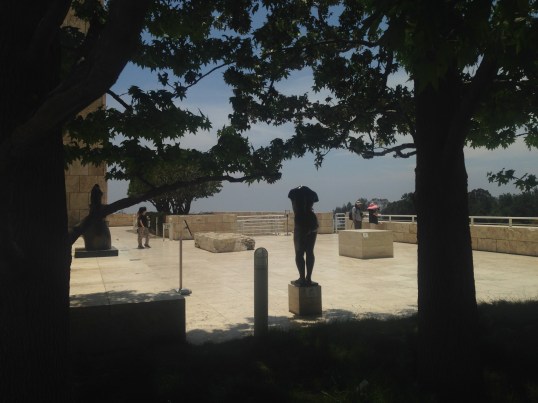
IMG_3070

That you can find a exterior museum view as breathtaking as anything inside. This is from the Getty Center.

IMG_3075

This, too. And:


IMG_3074


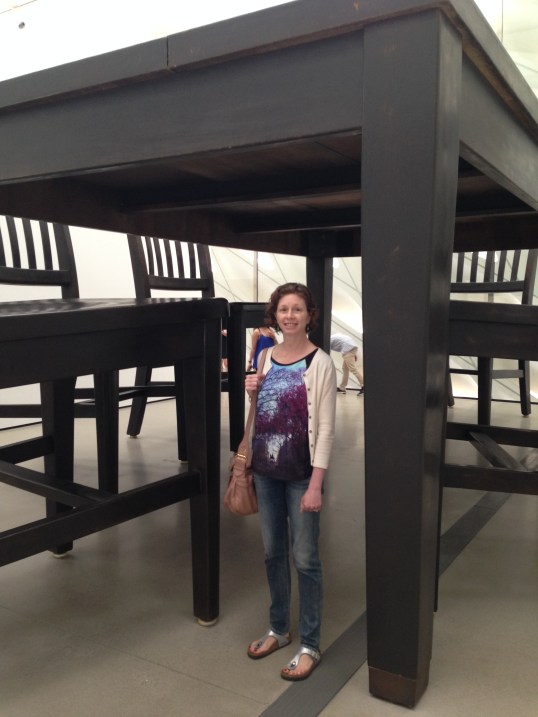
IMG_3081

At The Broad, Robert Therrien’s big table and chairs!

IMG_3077

Without warning: beautiful cacti.

IMG_3078

Paparazzi! They look like something…out of a movie! Here hanging outside of Craig’s restaurant on Melrose Ave. in West Hollywood. They shrugged when we asked who they were waiting for. “David Spade’s inside,” one offered. David Spade…who knew he was still famous?


An End and a Beginning

My daughter has graduated from high school. It’s been two weeks but I’m still up to my chest in emotion, all the stronger this time around because she’s my youngest child.

There’s no holding back the swelling pride and wonder that comes along with seeing your child, in the long black robe, walking down the aisle as you look on, in this case under the vast vaulted nave of St. John the Divine in northern Manhattan.

It was a joyful, celebratory day, but—underneath it all, for me, the sadness of knowing that life as I know it—the parenting life—is coming to an end. Do I have to say I’m empty nester? The bird analogy is so cheesy.

Do people who are empty nesters actually call themselves empty nesters? I’m starting to think only people who are about to be empty nesters—and are dreading it, like I am—use that term. Sort of like people who are about to turn forty or fifty can’t stop talking about how awful it is to be turning forty or fifty. Once you’re actually there, once the condition is real instead of speculative, then you don’t need to label it. You’re simply in it. It’s once again your life, but a new way of living in which the kids are in college. Once they are out of college, they are officially grown up. “Our children are grown.” I’m going to feel so old when I have to start saying that. That’s a whole other issue: How old I’m going to feel without kids in the house. There’s no getting around it. Once you have to say your kids are in college, people know pretty much how old you are. They know you’re at least in your 40s, and probably older. Which is fine, I’m not at all trying to hide my age, but it’s just unsettling, that the math is so obvious. It’s less so when you’re in your 40s and have toddlers. People may suspect you had kids late, but no one’s going to ask; it’s info that’s yours to share or not.

It’s weird to think of the free time awaiting us. Granted, Vanessa doesn’t take up a ton of time at this point; long gone are the crazy days of 6 am-9pm parenting. I’ll miss what little I do do, though. Making sure we have Vanessa-only foods—almond milk and almond butter, sweet potatoes and cartloads of bananas and those amazing dark-chocolate-covered pretzels from the fancy market around the corner. Come to think of it, keeping her fed is the main thing. I love that role. I’ll miss having coffee with her in the morning before school, one of the day’s few quiet moments. I’d commiserate about tests coming up, with any luck get a snatch of high-school gossip. Only a few moments, ten, fifteen minutes. Then a few words maybe after school, but then then we convene again at dinnertime. We mostly love the same foods and on weekends we cook together. It’s usually just the two of us, because Dan travels frequently and is often home late. Throughout the kids’ childhood, he’s rarely been home when the kids ate at 6:30 pm. Vanessa and I still generally eat around then. When she leaves, so will the dinner routine of twenty years. That’s an odd thing to contemplate. I’m likely going to have many nights when I’m on my own for dinner. Will I go European and have something like soup or bread and cheese? Will I drag empty-nester friends out to hip Bklyn eateries? I could become a regular at a cool but low-key local joint (there are some definite possibilities in my ‘hood). “I’ll have my usual, Louie.”

I have to concentrate on how absolutely great it’ll be to have all this new time—for writing, for one thing—and not on why I have all this free time. I get all weepy when I think about all that is coming to an end—not just child-rearing but a twenty-year period that looking back, were the bounty years. The years of being young but with responsibilities, years of energy and ambition, when the future was still vast.

I know I’ll shake off this melancholy and come to terms with the next stage. I figure by mid-fall—a month or two after Vanessa’s gone. With my first-born, Davison, I moped for three months, but everything’s faster the second time around. I’ll shoot for one month, because I have a terrible feeling Vanessa will has some kind of school break come October, and I’ll need to be on solid emotional footing by then. Wish me luck.

Thoughts on Hemingway

Generation gap? My daughter, Vanessa, is reading Hemingway’s The Sun Also Rises and can’t stand it. In her view his characters do no more than meander through life, glass in hand. “All they do is drink,” she says disdainfully.

I, too, read Hemingway in high school (hasn’t everybody?). But I found all the drinking, amid the bull fighting of Pamplona, kind of glamorous. Drinking counts as doing something, doesn’t it? Then again, when I was my daughter’s age—18—I liked beer and wine and had already discovered that rum gave me a crushing hangover. Vanessa doesn’t like any kind of alcoholic beverage I can see it might be difficult to settle in with Jake Barnes in The Sun Also Rises if you aren’t wondering what a Jack Rose is—one of the drinks Jake orders—and half wishing you were in the Paris hotel bar with him. (Turns out a Jack Rose is composed of applejack, grenadine and lemon or lime juice. Hmm. Not sure what to make of it.)

The drinking scenes throughout Hemingway’s oeuvre are famous enough to have inspired Philip Greene’s Hemingway cocktail compendium, To Have and Have Another, a second edition of which came out last year.

Of course, the drinking is not the only reason Vanessa shuns Hemingway. She’s indifferent to the unvarnished style that made him famous. She finds it really boring. I’m fascinated by her confidence here. I don’t remember feeling as if I could not like Hemingway. We were expected to appreciate, if not revel in, the short declarative sentences, his insistence on cutting away everything but the essence, leaving the reader to interpret what is left unsaid. (That’s what I vaguely remember. If I’m misrepresenting Hem, let me know.)

Thinking about him now, I know I didn’t just like him because I was supposed to. That man could write. Okay, he was clearly a male chauvinist pig. But he could write. Here’s something he once said about the training of a would-be writer, in an interview with Paris Review editor George Plimpton, back in 1958 (as printed in Newsweek):

“Let’s say that he should go out and hang himself because he finds that writing well is impossibly difficult. Then he should be cut down without mercy and forced by his own self to write as well as he can for the rest of his life. At least he will have the story of the hanging to commence with.”

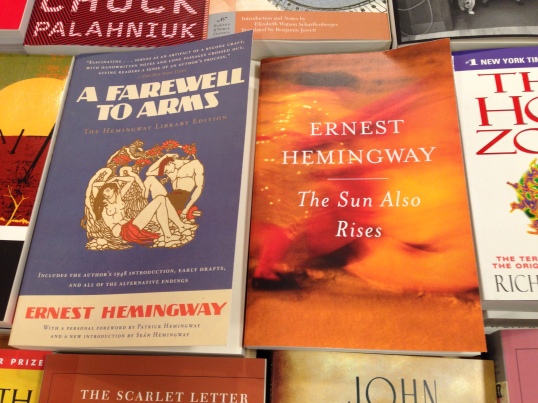
P.S. In my local Barnes & Noble, on the “Books Everyone Must Read” table, two Hemingway classics lie front and center:


teIMG_2935

I spotted For Whom the Bell Tolls on another side of the table, along with The Old Man and the Sea. He was the only author to have more than two books, and only two had more than one–Gabriel Garcia Marquez and Kurt Vonnegut. What does this mean? Is it a reflection of Hemingway’s stature in American literature? Are the B&N staff composed of big fans? The former seems more likely than the latter.


Stories from the Past

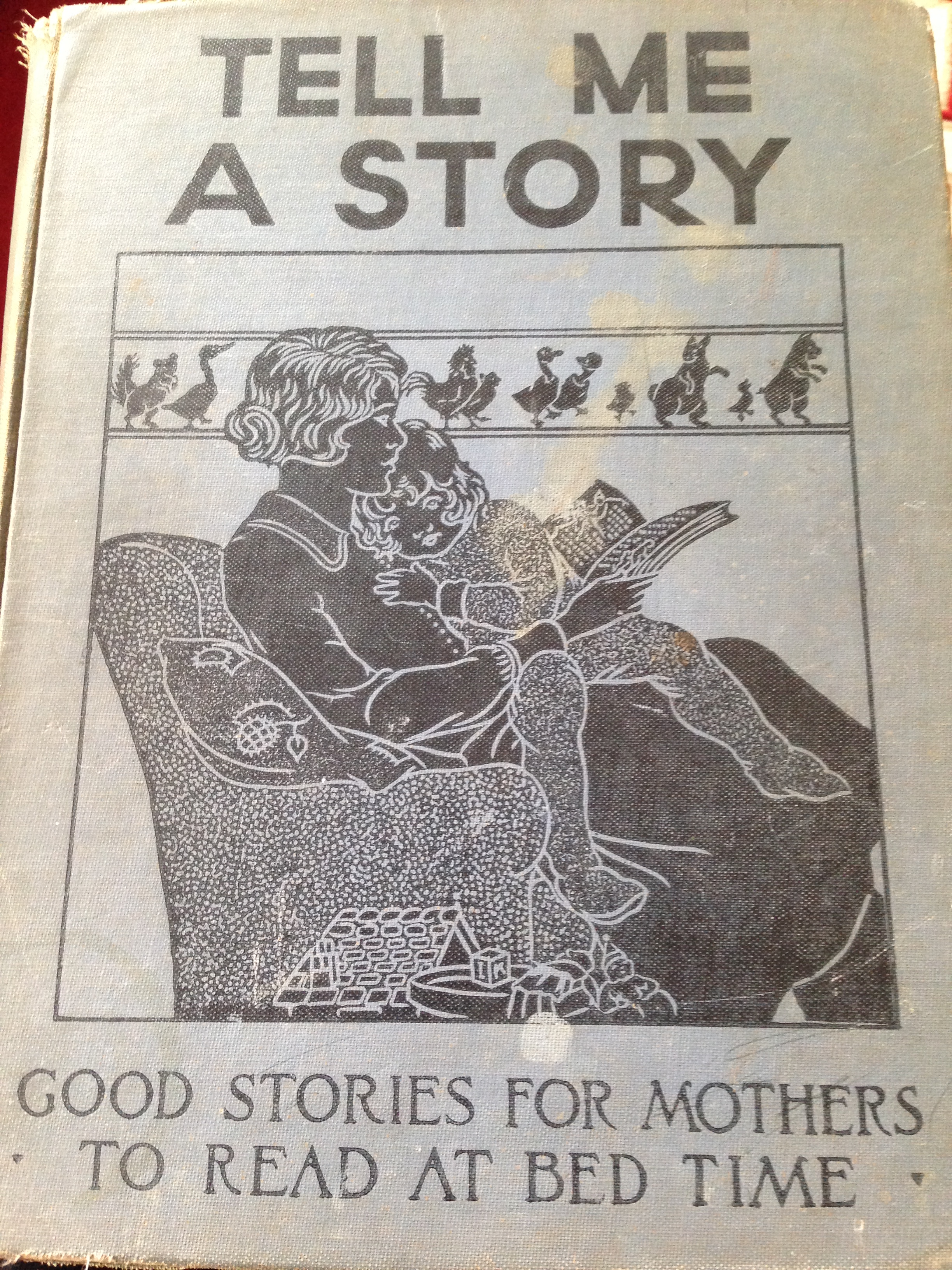
IMG_2921.JPG

This book was sitting on a stool outside of a second-hand store calling to me. It was published in 1932 (there were four copyrights, and ’32 was the most recent). The name of a onetime owner—the last?—is Eulalia M. Cunningham. (I’ve heard of Eulalie but not Eulalia—lovely name. Lilting.) Her name is written on the copyright page, along with the words “Christmas 1944.” On the front page, in a more childish script, Eulalia herself (I’m guessing) wrote, “E. Cunningham, and then, having realized she forgot something, “E.M. Cunningham.” She added a Christmas sticker to the page, just the way a child would—it’s randomly placed on the left side of the page, toward the bottom—just where it happened to come off her fingers. A man and a woman in a sleigh, with a Christmas tree sticking out the back. Just think—a seventy-two year-old sticker!

The title page says the stories are selected from John Martin’s Book, which was a popular children’s magazine, aimed at five- to eight-year-olds, published from 1912 to 1933. (Thank you, Google.) John Martin was a pseudonym of founder Morgan Shepard. I couldn’t find any info on why it folded, but far bigger enterprises than this failed during the Great Depression. John Martin’s Book must’ve continued to resonate with readers if this book was available for purchase in 1944. (It’s not easy to find a ten-year-old book these days—not unless it’s an enduring classic.)

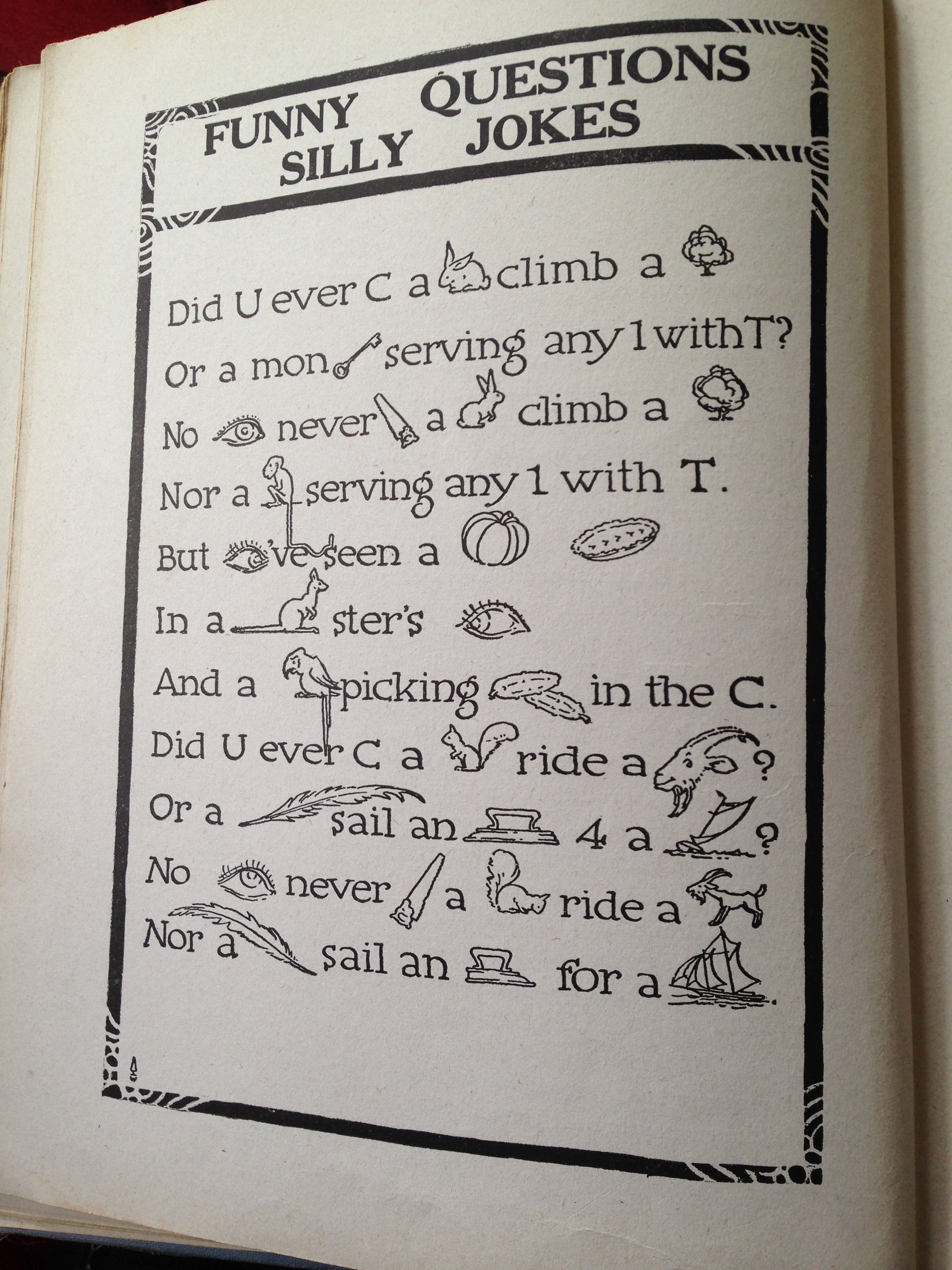
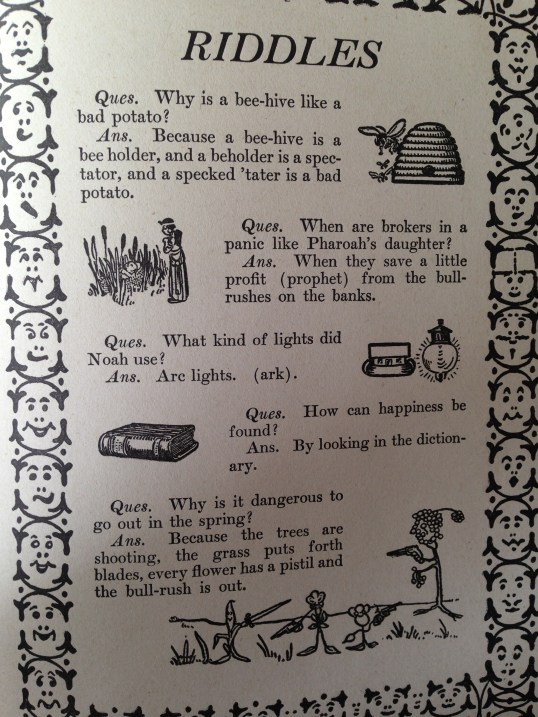
This is one dense book, with marvelous black-and-white drawings on nearly ever page. There are not just stories but poems, biographies, riddles and even pictograms.

Check this out:

IMG_2920.JPG

I can’t figure out the meaning of the line with the feather and the flat iron. A feather sail an iron for a ship?

Riddles! These are kind of complicated. And a bit weird. Hats off to the five- to eight-year-olds who are getting these:IMG_2926

There’s always something about stories from past eras that startles or even shocks. In a few of the stories here, people get hurt, and good. “Tommy Elephant Discovers the Railroad,” a monkey named Fibber-Jibber convinces Tommy that a strange creature running along a new jungle trail wouldn’t dare hurt as large an animal as Tommy. So Tommy stands on the train tracks, in front of an oncoming train. Yikes!  He gets hit, naturally. There’s an illustration showing the elephant, head over heels, while the train rushes past. He’s not killed, which he surely would be in real life, but he’s badly bruised—-much to Fibber-Jibber’s amusement. It’s hard to imagine this was ever funny to anyone, but it must’ve been. Americans of the early 20th century clearly didn’t think of animals as stand-ins for boys and girls, the way we do today. At least not wild animals. (Perhaps that changed with Babar, published in 1931?) Fibber-Jibber gets a punishment of sorts. Using his trunk, Tommy hoses him repeatedly, until he’s a “very wet, but much wiser” monkey, who doesn’t play any more tricks on Tommy for a  “long, long, long” time.

There’s a tale called “Catskin,” which reads much like Cinderella except there’s no glass shoe and no stepsisters, and the heroine is, yes, wearing an outfit made out of—catskin! No wonder this story has slid into obscurity. Oh, and also, the cook beats the poor girl like nobody’s business. She’s forever breaking a ladle or a skimmer over Catskin’s head. Incredibly—thankfully—Catskin is always “none the worse.” She sneaks off to go to balls, where she meets a squire (not a prince, but quite good enough). Before long she marries him and lives happily ever after. With brain damage, no doubt.

There are Grimm-like stories like this one, but many others. The variety is pretty astonishing. Origin stories, such as how corn got its ear and how the woodpecker came to be. Christian stories—St. Francis convinces robbers to change their ways. A story about Mozart as a young boy. A tale about St. George and the dragon.

I can’t say the poetry impressed me, but I am impressed with the presence of the poetry. It’s so tough to get kids to read poetry today–to give it a chance!  Shepard, writing as John Martin, contributed a poem that I wouldn’t mind reading to little ones:

A Magic

One day I saw a rule hand
Rise up to strike a heartless blow,
It did not stop to count the cost,
It did not care to know.

And then I heard some gentle words;
They worked a magic, sweet and calm,
Their gentle power held that hand
So it could do no harm.

One day I heard an angry voice,
Its words would neither think no spare,
How deep they cut another’s heart
It did not know nor care.

And then your gentle words were said.
The angry voice to softness fell.
Repentance quivered in that voice
Beneath your magic spell.

Oh, it is strong, and fine, and good
To find what gentle words will do.
I’m sure that they are always best,
And bravest too—aren’t you?


I Feel Bad About My Eyebrows

Have you read Nora Ephron’s funny lament on necks? Her dermatologist told her the neck started to go around age forty-three, and sure enough, as she approached forty-three her neck started to go. She wrote, “One of my biggest regrets—bigger even than not buying the apartment on East Seventy-fifth Street, bigger even than my worst romantic catastrophe—is that I didn’t spend my youth staring lovingly at my neck. It never crossed my mind to be grateful for it.”

That’s how I feel about my eyebrows. For years they existed in a zone of my face, the above-the-eyes-area, that I never paid a whit of attention to. The forehead section. Who thinks about her forehead when she’s young and unlined? They were nothing special; regular, light-brown eyebrows that made sense with my reddish hair. I didn’t even pluck them, that’s how little I cared about them. Around forty, I started plucking them. I have to admit, I saw how eyebrows could give a bit of definition to the face. My eyebrows and I discovered one another. I took care of them, and how do they thank me? They disappear on me, like guests who slip out of a party without saying goodbye to the host.

It’s my right brow in particular. There’s a piece of it that’s gone missing, right smack in the middle. If an eyebrow is something like a comma, I’m talking about the mid-point of my comma’s tail. I use a pencil to make the bridge, but I can’t believe I’m at this point: penciling in an eyebrow! I used to think I wasn’t going to have to do that until I was eighty.

Here’s something interesting: My twin sister Hilary doesn’t have this problem. Her eyebrows are fine, How is that even possible, since we’re genetically identical? Environment must be to blame—living in New York instead of Philly, where Hilary is. Her hair—on her head—is thicker, too. Twin researchers: Does where you live determine how much hair you lose as you age? Get on this!

All things considered, I’m lucky. I know that. I’m not facing baldness, like so many men I know. My teeth aren’t falling out (yet). I won’t even go into the countless other more serious conditions that an aging human faces. Then there’s the sagging flesh issue. Oh, let’s not go there.

The Lure of Donna Tartt’s The Goldfinch

IMG_2732.JPG

This is my 21-year-old son Davison, reading during spring break from college.

Reading! Proof that college students still read books when they’re not in school. And he happened to be reading a book I gave him, Donna Tartt’s The Goldfinch. I can’t even express how happy this makes me. I gave it to him for Christmas, thinking, He has to read this book—everyone has to read this book, even as I doubted whether he’d get to it anytime soon. It’s 771 pages long, after all, and he was about to embark on another term of challenging classes. But he took it back to school with him, and lo and behold, he was in the thick of it by the time I saw him in March. I asked him what he thought, and he said he wanted to see Theo, Tartt’s protagonist, catch a break, just one. I knew exactly what he meant. Tartt sucks you into a world that is so vividly rendered and so painful for Theo that you feel like you are suffering alongside him, an invisible companion who can’t do anything but watch and worry and hope that happiness is just around the bend. Then Tartt turns around and challenges our assumptions about what constitutes a meaningful life. At the end, Theo tells us, “We can’t choose what we want and don’t want and that’s the hard lonely truth. Sometimes we want what we want even if we know it’s going to kill us. We can’t escape who we are.” It’s not an uplifting book, but it’s an unforgettable one.

I feel lucky that Davison’s formative years came before technology seeped into every crevice of of everyday life. When he was six or eight, computer games were new, and we had maybe one or two. (I remember the Freddy the Fish game—pretty cute, as I recall. Freddy helps you on a deep-sea treasure hunt.) He didn’t have a cell phone until he was thirteen—one of those flip phones. There was no texting or apps. I can’t make any statements of fact here, but I believe that he read more in his free time than he might’ve had he had access to social media, the Internet and the vast array of computer-based games that exist today.

Studies on kids and reading are troubling. Only about half of kids ages six to eight are reading daily; that number falls to a quarter by age fifteen. According to one study, the percentage of seventeen-year-olds who never or hardly ever read has gone from 7% to 27% in the last thirty years. (I’m assuming the study is referring to reading for fun. Schools may have eliminated art, music and physical activity—at least in New York City—but they’ve hung onto the three Rs. For now.) How do we keep reading books a part of the picture? It’s up to parents. We need to read to our kids when they’re young—from the time they are babies for as long as they’ll let us. It’s the only way to instill a love of reading and stories (which I can’t believe aren’t innate in kids). And then we have to encourage them as they learn how to read. We need to help them choose books and bring them books and make reading a family activity.

This is pretty obvious stuff, I know. Also, it doesn’t always work. My sister says her two boys, 10 and 12, are off books. Period. Nothing to be done. If it were me, I’d keep trying. Just like you don’t give up trying to get your kids to eat vegetables, you have to keep trying with books.

The sound of E.B. White

Plangent.

Do you know that word? I’m reading about Shakespeare’s ability to summon “plangent feeling,” as well as “robust comedy” and “penetrating psychology” in the four history plays currently being put on by the Royal Shakespeare Co. at the Brooklyn Academy of Music. The admiring words come from New York Times theater critic Charles Isherwood, whose reviews (quite good) don’t usually cause me to pause and think, “What was that?” I was sure there was a typo of some kind—could he have meant “urgent”?—but no, plangent’s a word. It means a loud, reverberating, often melancholy sound.

The plangent sound of bells. That’s the example dictionaries like to give. How about the plangent moo of a cow? The plangent drone of a garbage truck at 4 am? (That sound might be more grating than melancholy.)

The noun is plangency. That doesn’t roll off the tongue, does it? Doing a bit of online research, I found that Newsweek once described E.B. White’s audio-book reading of Charlotte’s Web as having “a plangency that will make you weep.”

Oh, leave it to a journalist to use a fancy, un-child-like word in a story about a children’s book! I’m allowed to complain; I was a journalist once. Still I have to admit it’s an interesting use of plangency, and if anyone could summon that kind of sound, maybe it would be E.B. White.

I like saying “plangent.” It’s not onomatopoeia, but it’s a nice meaty word. Or as Isherwood might say, muscular. I’m not picking on him, just noticing his review includes a word that seems to be in vogue as an alternative to robust, powerful, dynamic. He calls some of the scenes in Shakespeare’s Henry IV “muscularly staged”. When I read that, I honestly think of men with bulging calf muscles, which you might well see in a Shakespeare play involving kings and courts. I myself use “muscular” in the old way, to refer to someone’s physical state. (I’m all for bulging biceps.)

I see I’ve fallen into the habit of writing about words I don’t plan on using, instead of the ones I do. Get with the program, Alex!

P.S. David Tennant, the Scottish actor, is starring in Richard II at BAM right now. Only standing-room only tickets right now. (I’m mulling whether I could stand for two-plus hours). If you haven’t seen Tennant in the 2013 TV series Broadchurch, and if you have Netflix, and if you like murder mysteries set in small seaside English towns (and who doesn’t like those, I ask you?)—I urge you to download! There are two gripping seasons to watch, and another one being filmed this summer. He’s also incredibly good and creepy in the 2015 TV series about superheroes, Jessica Jones. “I don’t watch that much TV, I swear,” she cried plangently.

The Kind Way of Saying “No.”

canstockphoto16744792.jpg

I thought I’d heard most every way literary agents crafted rejections, but I’ve just heard a new one: “I’m not taking on any new clients right now.”

This is not about dumbies who don’t do their research and approach agents who aren’t open to queries. We’re talking about agents who don’t know how to say “No, I’m not interested.” Strange, isn’t it? Agents have to reject people, many people, every working day. In the course of a year, they receive thousands of queries and may take on only one, two, three new clients. What’s the big deal about just being honest?

I suppose it’s a kind way of saying no. The old chestnut, It’s not you, it’s me. “It’s not that your work doesn’t grab me—it’s just, I’m overworked, that’s the truth of it.” It’s flattering, almost. You might think you’d gotten really close. Who could blame you? If only she weren’t sooo busy, she’d be my agent! But you could also look at it another way: She’s saying, “Take me off your list. Don’t bother contacting me ever again.”

No two agents reject in the same way, which at least gives a bit of interest to the depressing business of being rejected. I am partial to language that is vague but concise: “This isn’t right for me.” I’ve gotten over needing to know why it’s not right. I’ve come to recognize there can be many reasons, big and small; and given the volume of queries agents receive and have to respond to, on top of their actual work, I’m resigned to their not having time to elaborate.

If “I’m not taking new clients” is one of the kinder ways of saying no, one of the blunter ones is, “I can’t sell this.” I got this once from an agent. Ouch. I wish he’d prefaced it with “I like this, but…” to cushion the blow. But let’s face—if he liked it, he might’ve suggested revisions. He might’ve said, “If you do this and this, I’ll consider reading it.”

Anything that isn’t a yes is a no.

Post Navigation